

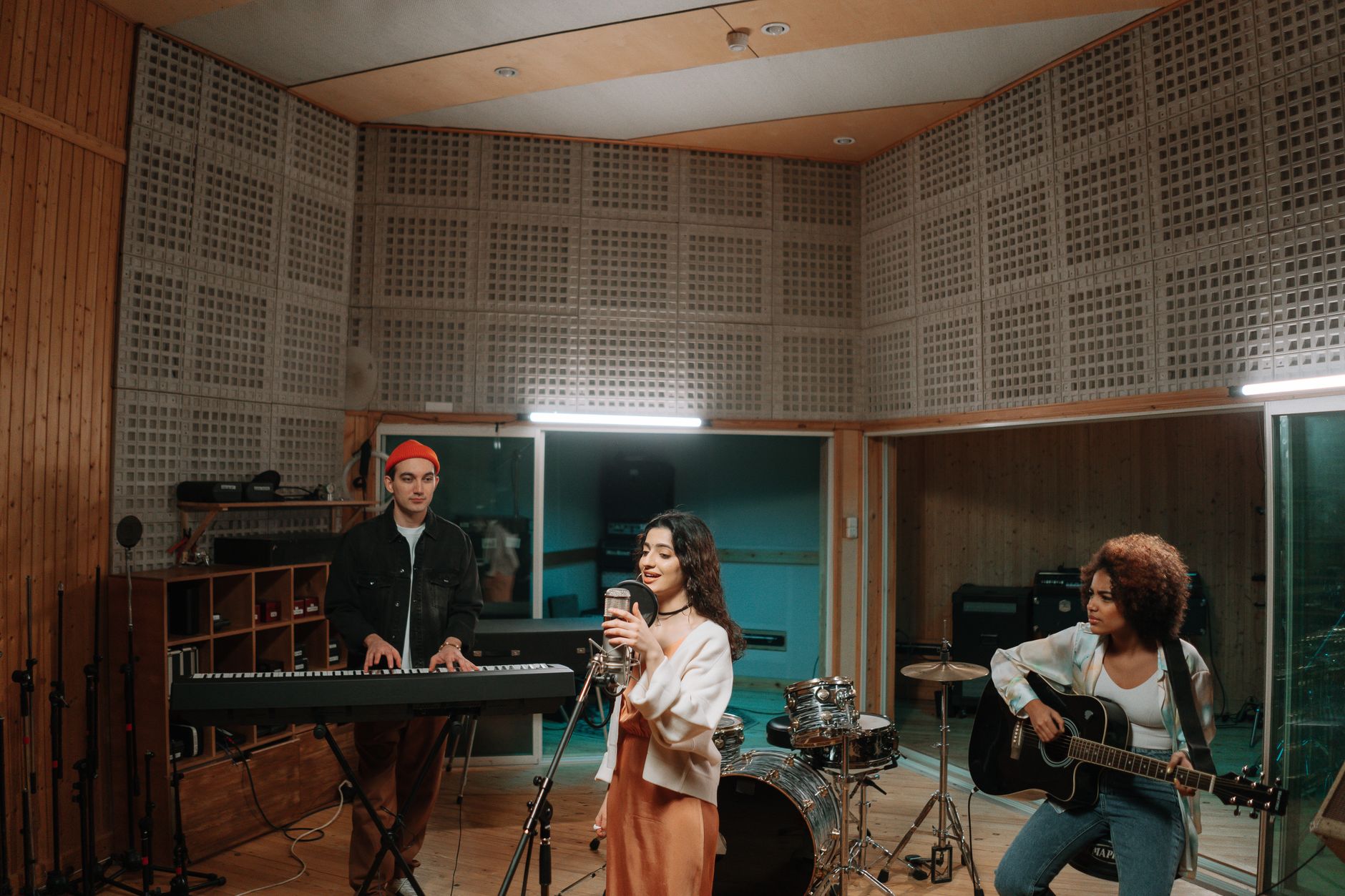

HVAC systems and sealed rooms can drive indoor relative humidity down to unsafe levels, and a purpose-built unit holds the range between 40% and 55% while running quieter than 30 dB to protect wooden instruments, condenser microphones, and vocal cords. Studios in cold-winter cities often see indoor RH plunge below 20% overnight, and that is the threshold where guitar tops crack, Shure SM7B diaphragms stiffen, and static zaps start frying preamp inputs mid-session.
The following sections explain how engineers in home and project studios can pick a quiet, clean humidifier that protects guitars, mics, and gear from wintertime dryness without adding hiss to the room.
Why Humidity Matters Inside a Recording Space
Most studios run sealed rooms with aggressive air conditioning, and AC strips moisture the same way a dehumidifier does. The result is a tracking space that feels crisp and quiet but slowly desiccates everything in it, from spruce tops on a Martin acoustic to the mylar diaphragm inside a Neumann U87.
Below 35% relative humidity, wood loses cell-wall moisture faster than it can reabsorb it. Acoustic guitar tops belly inward, fret ends protrude past the neck edge, and piano soundboards develop hairline cracks that no luthier can fully repair. Drummers feel drumheads tighten and choke sustain on snare drums, while string players wake up to tuning instability between sessions.
Vocal Strain and Microphone Damage
Dry air hits vocal cords the same way it hits a guitar top. Singers feel scratchy, breathy, and fatigued after 20 minutes, which means more retakes, more comping, and more wasted session hours. When RH climbs above 70% on the opposite end of the dial, condenser microphones and ribbon mics suffer because the diaphragms absorb moisture, corrosion creeps onto backplates, and the once-pristine top-end response turns dull within a season.
Static electricity from chronically dry air is the silent killer of studio electronics. Static discharge can pop a preamp, corrupt a hard drive, or introduce clicks that ruin an otherwise perfect take. A grounded humidifier placed on a hard floor reduces these discharges by raising surface humidity above the 30% static-risk threshold.
The Target Range Studios Should Hold Year-Round
Recording studios should maintain relative humidity between 40% and 55% to protect instruments and equipment. Drift outside that band for more than a few hours starts to affect tuning stability, vocal comfort, and mic response, which is why a logged hygrometer matters more than the humidifier itself.
Temperature interacts with RH in ways many engineers overlook. Aim for 68 to 72°F paired with your humidity target, because warmer air holds more moisture and can push your effective RH above 60% even when the humidifier is idling. A digital hygrometer with data logging, like the Vaisala HMP60 or any AHAM-certified thermal hygrometer, captures overnight swings and session-long drift that a glance at a wall dial misses entirely.
Comparing Humidifier Technologies for Studio Use
Studio humidifiers fall into four technology families, and each behaves differently in a quiet room. Pick the wrong one and you introduce fan noise, bubbling, or mineral dust into a $10,000 signal chain.
| Technology | Noise Level | Mineral Output | Best Studio Use |
|---|---|---|---|
| Ultrasonic humidifier | Below 30 dB | High (needs distilled water) | Vocal booths, control rooms |
| Evaporative humidifier | 25 to 40 dB | Low | Live rooms, tracking spaces |
| Steam vaporizer | Silent at output, ticks during heat cycles | None | Studios near electronics, sterile rooms |
| Warm-mist humidifier | 35 to 50 dB | Low to moderate | Booths only when other options fail |
Why Ultrasonic Leads for Critical Listening Rooms
Ultrasonic humidifiers for a recording studio vibrate water at 1.7 MHz, producing a cool mist with no fan and no moving air. The result is a sound floor below 30 dB, quieter than most computer fans, and a footprint small enough to sit on a shelf six feet from your console. The trade-off is mineral aerosol, which is why paired use of distilled or reverse-osmosis water becomes non-negotiable.
Evaporative units pull air through a saturated wick filter, so output self-regulates as RH climbs. They cannot over-humidify a sealed room, which is a major safety plus when the studio is unoccupied overnight. Wick filters need monthly replacement to prevent microbial growth, so factor that recurring cost into your choice.
Sizing the Unit to Your Room and Session Length
Humidifier capacity should match room volume, and roughly 1 gallon of daily output covers 500 square feet under normal conditions. A 150-square-foot vocal booth needs a compact 1.5 to 2 gallon tank, while a 600-square-foot tracking room wants a console-style unit like the AprilAire 600 mounted in an adjacent storage closet with a ducted supply.
Matching Tank Size to Session Length
Tank size determines refill frequency, and an empty tank mid-take is the exact failure mode that ruins vocal sessions. For a three-hour tracking day in a 200-square-foot booth, a 4-gallon tank running at medium output covers the entire session without a refill. Smaller 1.5-gallon units demand a check at the 90-minute mark, which interrupts creative momentum.
- Under 150 sq ft: 1.5 to 2 gallon ultrasonic, output set to low.
- 150 to 300 sq ft: 4 gallon ultrasonic or evaporative, humidistat required.
- 300 to 600 sq ft: Whole-room console with ducted supply, 6+ gallon daily output.
- Above 600 sq ft: AprilAire 600 or equivalent, mounted outside the critical listening area.
Keeping White Dust, Noise, and Moisture Off Your Gear
Distilled or reverse-osmosis water prevents mineral aerosols from settling on console faders and mic capsules. Tap water carries calcium and magnesium that ultrasonic vibration breaks into a fine white powder, and that powder migrates straight onto every open fader cap and ribbon mic in the room. A countertop RO system pays for itself inside a year for any studio running daily sessions.
Place ultrasonic units at least six feet from mixing desks, computer screens, and outboard rack gear. Mist plumes travel on air currents you cannot see, and a six-foot buffer keeps the densest part of the cloud away from metal surfaces. Pair the placement with a humidistat set to 50% so the unit idles the moment your target band is reached.
Enable auto-shutoff and humidistat controls so the unit idles when RH reaches the ceiling of your target band. Unattended over-humidification is the fastest path to corroded backplates and warped drum shells.
For rooms that cannot tolerate any particulate, even filtered, switch to a steam vaporizer. The boiling process leaves minerals and microbes behind in the chamber, so the output is essentially pure water vapor. The trade-off is current draw and a faint tick during heating cycles, which is why placement matters even with the quietest steam unit on the market.
Placement, Monitoring, and Long-Term Maintenance Habits
Position the humidifier on a stable surface away from studio monitors, subwoofers, and isolation pads that could vibrate. A wobbly shelf turns a 28 dB ultrasonic into a 40 dB rattle, and even a small buzz bleeds into ribbon mic takes during quiet passages. A rubber isolation mat under the unit solves most vibration complaints.
Monitoring and Seasonal Adjustment
Pair the unit with a wall-mounted or tabletop hygrometer and review logs weekly for seasonal drift. Winter heating often drops baseline RH by 10 to 15 points, which means raising output to compensate, and summer AC can push RH high enough that you actually need a dehumidifier on standby. Smart humidifiers from Honeywell, Levoit, and Vornado now ship with app-based logging that flags these swings before your guitar tops notice.
Descale tanks monthly and replace wick filters on evaporative models to prevent microbial growth near microphones. A biofilm-coated wick is a breeding ground for bacteria and mold spores, and those spores ride the mist straight into your vocal booth. A 30-minute vinegar soak once a month keeps the tank clean and the output sanitary.
Once placement is set and the tank stays sanitary, the remaining variable is what actually flows through the unit and into the air.
- Weekly: Check hygrometer logs, top off tank, verify humidistat setpoint.
- Monthly: Descale tank, inspect wick filter, wipe down mist nozzle.
- Seasonally: Re-evaluate output for heating and AC load shifts.
- Annually: Replace wick filters and ultrasonic membranes as needed.
Recording Studio Humidity Level and Water Quality Decisions
Studio humidity control depends as much on water quality as on the humidifier you choose. Distilled or reverse-osmosis water keeps mineral aerosols off your console, while tap water leaves calcium dust on every fader within a week. Pair that water choice with a logged hygrometer and your gear stays inside the 40 to 55% RH band year-round.
Run the unit through a humidistat set to 50% RH, and revisit output each season as HVAC loads shift. Done right, the right humidifier becomes invisible: instruments stay in tune, vocals stay easy, and the gear keeps working for the next decade.
FAQ
What humidity level should a recording studio maintain?
Targets between 40% and 55% RH work well when paired with room temperatures of 68 to 72°F. This range keeps wooden instruments stable, prevents diaphragm corrosion in condenser microphones, and avoids the static discharge risk that appears below 30% RH.
What type of humidifier is best for a recording studio?
Running below 30 dB with no fan noise at all, ultrasonic models tend to outperform evaporative and steam options in treated rooms. Pair it with distilled or RO water to control mineral output, and add a humidistat so the unit idles at 50% RH.
How loud should a humidifier be for studio use?
Keeping output under 30 dB prevents the unit itself from bleeding into close-miked vocals and ribbon takes. Ultrasonic units typically hit that mark, while evaporative models often run 25 to 40 dB depending on fan speed.
Do humidifiers damage studio equipment or microphones?
Climbing past 70% RH, or letting mineral dust settle on capsules and faders, is where damage actually starts. Distilled water, a six-foot placement buffer, and a humidistat set to 50% prevent both failure modes.
How much humidifier capacity do I need for my studio size?
Studio humidifier capacity scales at roughly 1 gallon of daily output per 500 square feet. A 200-square-foot vocal booth wants a 4-gallon tank, and a 600-square-foot tracking room needs a console unit with at least 6 gallons of daily output.
Should I use a distilled or RO water system in my studio humidifier?
Use distilled or reverse-osmosis water in any studio humidifier that aerosolizes moisture, including ultrasonic and impeller models. RO or distilled input prevents the white calcium dust that tap water leaves on console faders and mic diaphragms.