


When the heating season kicks in, indoor relative humidity (the amount of water vapor in the air as a percentage of what the air could hold) often drops into the teens, and your skin, sinuses, wood floors, and guitar bodies all feel it. A whole-house evaporative humidifier tackles that problem at the source by pushing moisture into the airstream your furnace already circulates, instead of relying on a tabletop unit that only reaches one room. The seven picks below cover everything from installed furnace models with serious daily output to plug-in smart units for renters who can’t cut into ductwork.
The Main Contenders

AprilAire 600M Whole-House Humidifier, Manual, Up to 5,000 Sq. Ft.

AprilAire 500 Whole-House Humidifier, Automatic, Up to 3,600 Sq. Ft.
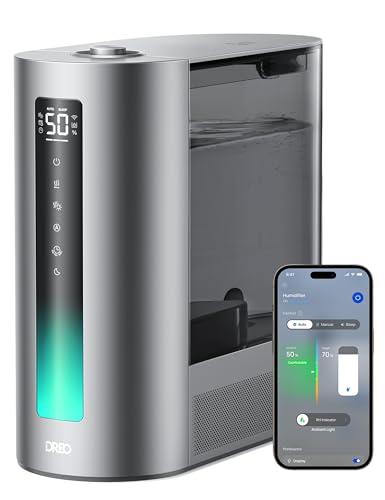
DREO 6L Smart Humidifier, Warm & Cool Mist

DREO 11L Smart Humidifier 747S, 700 Sq. Ft.

DREO 6L Smart Humidifier, 60H Runtime
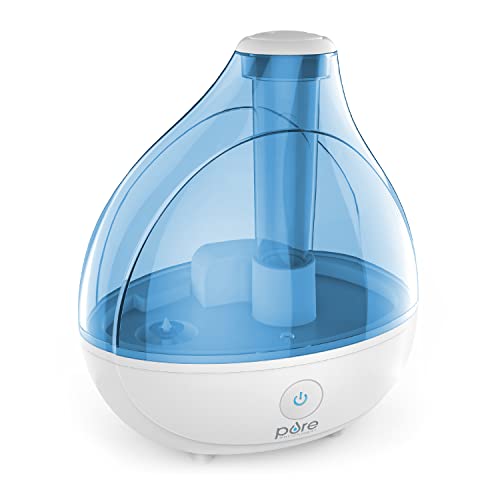
Pure Enrichment MistAire Ultrasonic Cool Mist Humidifier

Pure Enrichment PureBaby Ultrasonic Cool Mist Humidifier
Inside Each Recommended Option
The AprilAire 600M is the workhorse end of the lineup, designed for tightly sealed homes up to roughly 5,000 square feet where a smaller unit would barely dent the dryness. It bolts into the supply or return plenum (the sheet metal trunk that carries heated air from the furnace) and runs off the furnace’s hot water line, so you don’t babysit a reservoir. A single built-in sensor and manual control let you set a target without overcomplicating the wall hardware, which keeps installation and ownership straightforward.
Compared with the DREO smart units later in this list, the 600M trades app control for raw daily output and the kind of “set it once per season” operation most homeowners prefer. You will, however, want an HVAC tech or a confident DIYer to handle the initial install, including a saddle valve (a self-piercing fitting that taps into the water pipe) and bypass setup. For most homes north of 3,000 square feet, the moisture lift per day is the main reason it earns its spot here.
Where It Delivers
- Daily output of 17 gallons, which can keep a large tightly built home in the 35 to 45 percent range on the coldest days.
- Hard-piped water supply means no refilling tanks or hauling jugs upstairs mid-winter.
- Manual humidistat-style control keeps wall hardware simple and the failure points minimal.
- Mounts on the ductwork so moisture distributes through the same ducts that already heat the home, no extra fans needed.
Things To Consider
- Installation is more involved than a plug-in unit, and the bypass or power-mount setup may not fit a tight mechanical room.
- Annual water panel (the replaceable filter pad where evaporation happens) replacement and seasonal cleaning add to ownership time.
- No Wi-Fi, so adjusting the target means walking to the furnace closet.
Key Specs
Made For
Owners of large, tightly built homes with a forced-air furnace who want high daily output and a hard-piped, low-maintenance setup once it’s installed.
Where Another Pick Suits Better
Renters or anyone without a forced-air system should consider the DREO 11L Smart Humidifier 747S, which is a plug-in unit that needs no ductwork at all.
Step down to the AprilAire 500 and you get the same whole-house evaporative approach in a package sized for typical family homes, with capacity to cover up to about 3,600 square feet. The “automatic” label refers to the wall humidistat that monitors incoming air and tells the unit when to run, instead of forcing you to flip a manual dial each morning. For most households in the 1,500 to 3,000 square foot range, this lands in the sweet spot between the 600M’s brute force and a portable unit that never quite reaches the back bedrooms.
The catch is the same as the 600M: the unit itself is only part of the project. You still need a water line tap, a place to mount the unit on the duct, and a spot for a 24V transformer (a low-voltage power supply that drives the solenoid valve) or direct-wire connection. Once it is in, owners commonly report the home stays noticeably more comfortable and wood floors stop gapping, which is the kind of feedback that keeps a unit in service for a decade.
Benefits That Matter
- Automatic humidistat-driven operation means the unit only runs when humidity actually drops, saving water and energy.
- Daily output scales with the model to handle homes up to about 3,600 square feet, which covers most single-family layouts.
- Designed and manufactured in the USA by the brand that introduced the first whole-home evaporative unit decades ago.
- Compatible with standard furnace ductwork and a separate wall-mounted control.
Worth Noting
- Annual water panel replacement and seasonal cleaning are non-negotiable for healthy operation.
- Initial install benefits from a pro, so budget time or service-call costs beyond the unit itself.
- Lacks the high-output 17-gallon daily capacity of the 600M, which matters in extreme cold snaps.
Feature Snapshot
Best Suited To
Mid-size homeowners with a forced-air furnace who want automatic humidity control without stepping up to the 600M’s daily output.
Consider Something Else When
Apartment dwellers and anyone without a forced-air system will get more from the DREO 6L Smart Humidifier, which simply needs an outlet and a water tap.
The DREO 6L Smart Humidifier is the first item on this list that breaks from the installed-furnace category, and that is exactly the point. It is a freestanding 6-liter tank unit that pushes warm or cool mist into rooms up to around 550 square feet, which covers most primary bedrooms and many open living areas. The “MistWave” element is what produces the warm output, and the 40-inch mist plume is tall enough to disperse above furniture rather than pooling on the floor.
Where the AprilAire models earn their keep by serving the whole house through ductwork, this DREO earns its keep by serving a single zone really well. It is also a real comfort upgrade over passive cool-mist units in cold bedrooms, where a warm plume feels less like stepping into a damp basement. Keep in mind the unit is ultrasonic, meaning it uses high-frequency vibration to break water into a fine mist, which can leave a light white dust on nearby dark surfaces if you use hard tap water.
Real-World Strengths
- Warm mist reaches a comfortable output in about five minutes, which helps in cold winter bedrooms.
- 6L tank supports multi-day runtime on moderate settings, so you do not refill every night.
- Three control modes give you a meaningful difference between low, high, and warm-mist operation.
- Top-fill design simplifies refilling compared with units that require you to flip the tank upside down.
Points To Keep In Mind
- Covers roughly 550 square feet, so it will not reach the far end of a long ranch on its own.
- Ultrasonic units can leave fine white dust on electronics and dark wood if you skip distilled water.
- Larger footprint than a typical bedroom humidifier because of the 6L tank.
Quick Facts
Right Fit For
Bedroom-focused users and renters who want warm-mist comfort without touching the furnace or hiring an installer.
Not Your Match When
You need whole-house coverage, in which case the AprilAire 500 or 600M mounted to the ductwork is the more honest answer.
The DREO 747S is the “leave it alone” option in the portable category. An 11-liter tank keeps it running for up to roughly 100 hours on lower settings, which is the kind of number that means you stop thinking about the humidifier entirely. Coverage stretches to about 700 square feet, and a 6-foot mist plume helps the moisture reach the back of open living areas rather than dying near the unit. The rated 21dB noise floor is genuinely library-quiet, which matters more than spec sheets admit if you sleep near the unit.
Compared with the DREO 6L Smart Humidifier, this one trades warm-mist capability for raw capacity and quietness. It is the better pick for a large living room, finished basement, or main floor where you want moisture to reach multiple seating zones without a second unit. You still get the usual ultrasonic caveats, so plan on using filtered or distilled water if your home has hard water and you want to avoid white residue.
Useful Highlights
- 11L tank supports up to 100 hours of continuous runtime, which is rare at this footprint.
- 21dB operation is quiet enough to live next to a bedside or a home office desk.
- 6-foot mist plume helps moisture distribute across open-plan rooms rather than near the unit.
- 700 sq. ft. coverage handles most living rooms, primary bedrooms, and finished basements.
Honest Caveats
- No warm-mist mode, so the cool output feels brisk on the coldest winter nights.
- Large tank means the unit takes up meaningful floor or shelf space, so it is not the smallest pick for tight nightstands.
- Filter changes and tank cleaning are still required to keep the ultrasonic plate (the metal diaphragm that vibrates to create mist) running cleanly.
Who Will Love This
Anyone running an open-concept main floor or large bedroom who wants to fill the tank once a week rather than every other day.
Skip It When
You specifically want warm winter mist, in which case the DREO 6L Warm & Cool Mist unit is the better fit for that single feature.
The second 6L DREO on this list is the connected-home version, designed for people who would rather not walk over to the unit to bump the humidity up at night. The onboard sensor drives an auto mode that adjusts output to your target, and the DREO app plus voice assistant support let you change settings from the couch, the office, or the car on the way home. The 60-hour runtime is shorter than the 747S, but still respectable for a 6-liter tank on moderate output.
The honest trade-off is that smart features add a small layer of setup. You connect it to your home network, create an app login, and then keep the firmware reasonably current, none of which is hard, but it is more than the AprilAire units demand. If you already live inside a smart-home ecosystem and want humidity to react to your sleep schedule, this earns its slot.
Strong Points
- Auto mode uses an onboard sensor to adjust output without manual fiddling.
- App control plus voice assistant compatibility means you never have to leave bed to change settings.
- 6L tank supports up to 60 hours of runtime on lower settings, which suits a few nights between refills.
- Rated around 28dB, which is quiet enough for light sleepers in the same room.
Small Caveats
- Smaller tank than the 747S, so you refill more often if you run it on high overnight.
- Smart features need Wi-Fi and a phone, which is a small annoyance during network outages.
- Cool-mist only, so no warm plume option for the deepest cold snaps.
Perfect Match For
Smart-home users who want humidity to track their schedule and react automatically without manual adjustment.
A Better Fit Elsewhere
Shoppers who care more about quietness and long runtime than app control should look at the DREO 11L Smart Humidifier 747S instead.
The Pure Enrichment MistAire is the most stripped-down pick on the list, and that is its selling point. It is a small ultrasonic cool-mist unit with a 360-degree nozzle, two speed settings, and a tank that runs up to about 25 hours on low. That is enough to keep a small bedroom or home office comfortable overnight, and the small footprint means it fits on a nightstand or desk without dominating the surface.
Against the bigger DREO models, the MistAire clearly does less. There is no app, no warm mist, no auto-sensor logic, and the coverage ceiling sits around 250 square feet. Where it wins is the simplicity, the price-sensitive category, and the proven track record as a no-fuss bedroom workhorse. The optional night-light is a nice touch for guest rooms or kids who want a soft glow.
Useful Touches
- Tank supports up to 25 hours of runtime on low, which suits overnight use without refilling.
- 360-degree nozzle lets you aim mist in any direction from a single spot.
- Two speed settings cover a quiet low mode and a higher output for daytime humidity recovery.
- Small footprint suits nightstands, small desks, and tight shelving.
Factors To Consider
- Coverage is limited to about 250 square feet, so it will not service an open-plan main floor.
- Cool mist only, with no warm mode for cold winter rooms.
- Ultrasonic units need regular cleaning to keep the misting plate free of mineral buildup.
Built With In Mind
Bedroom, dorm, and home-office shoppers who want a no-frills cool-mist unit with a small footprint and simple controls.
Reach For A Different Pick When
You want warm-mist comfort or larger coverage, in which case the DREO 6L Smart Humidifier Warm & Cool Mist makes more sense.
The PureBaby is the MistAire’s sibling, rebuilt with a nursery in mind. The 1.5-liter tank is sized for a smaller room, the noise profile is tuned for sleep, and a built-in night-light turns the unit into a soft glow source alongside the mist. It is a 2-in-1 unit, humidifier and night light in one, which keeps the nursery surface area clear of extra gadgets. Coverage is rated around 250 square feet, the same as the MistAire, which is plenty for most nurseries and kids’ bedrooms.
Where the MistAire leans generic, the PureBaby leans into the room it was made for. The smaller tank means you refill more often, but in a nursery that is a feature, not a bug, since you are cleaning and refilling on a predictable schedule anyway. The night-light is gentle rather than bright, and the unit feels purpose-built rather than repackaged.
The Case For It
- Built-in night-light removes the need for a separate nursery glow source on the same outlet.
- 1.5L tank runs up to about 25 hours on low, which is a comfortable overnight window for a small room.
- Cool-mist operation is quiet enough not to compete with white-noise machines or sleep sounds.
- Sized for rooms up to about 250 square feet, which matches most nurseries and kids’ bedrooms.
Possible Compromises
- Smaller tank means more frequent refills than the MistAire, which has a larger reservoir.
- Cool mist only, so no warm option for the chilliest winter nights in a drafty nursery.
- Coverage is limited, so it will not double as a whole-floor humidifier as kids get older and roam more.
Whose Shelf It Belongs On
Parents outfitting a nursery or kid’s room who want a quiet humidifier and night-light in a single small unit.
Swap It Out When
You want a similar footprint but more general-purpose bedroom use, in which case the Pure Enrichment MistAire is the more flexible choice.
What to Weigh Before Choosing a Whole-House Evaporative Humidifier
Match the System to Your Home’s Air Handler
The first fork in the road is whether your home has a forced-air furnace. If it does, installed units like the AprilAire 500 or 600M push moisture into the existing ductwork and reach every room the furnace already serves, which is a real efficiency win. If you do not have ductwork, a portable ultrasonic unit from DREO or Pure Enrichment is the only realistic path, and you should plan to run one per major zone. The right answer depends on square footage, existing HVAC, and how comfortable you are cutting into ductwork.
Output and Tank Size Drive Real Comfort
Two numbers matter more than any marketing claim: daily output for installed units and tank runtime for portables. Output is measured in gallons per day (GPD), the volume of water the unit can evaporate in 24 hours, and a 17-GPD unit like the 600M will hold humidity steady in very large homes. For portables, focus on the tank’s stated runtime at your preferred speed, since a 100-hour tank like the 747S effectively removes refills from your daily routine. Bigger is not always better, but undersized units are the most common reason people feel their humidifier “does nothing.”
Maintenance Is the Long-Term Cost
Installed evaporative units need a yearly water panel swap and a seasonal clean, which is a small but non-zero cost in time and parts. Portable ultrasonic units need weekly tank rinses and periodic descaling (using a mild acid to dissolve mineral buildup) to keep the misting plate from clogging or shedding white dust. If you do not want to touch the unit, prioritize fewer features over fancier ones.
Noise, Smart Features, and Warm vs. Cool Mist
Quiet operation matters most in bedrooms, where anything above about 30dB starts to compete with white noise. Smart features like app control and voice assistants are nice but not essential, and they add a setup step that some households prefer to skip. Warm mist, like the DREO 6L Warm & Cool model offers, helps in the coldest rooms but costs more in energy per gallon of output.
Key Considerations Across These Picks
Common Shopping Slip Ups
A frequent mistake is matching coverage to home size, not to tightness. A 3,000-square-foot home that is drafty needs more humidification than the same square footage in a tightly sealed build, and a small unit will underperform in both. Another is underestimating water panel and filter replacement costs, which add up over a decade of ownership. You should also avoid skipping the manual reading on installed units, since bypass versus fan-powered setup changes the ducting work involved.
What the Higher Tier Buys
Stepping up from a portable to an installed unit like the AprilAire 500 or 600M trades app polish for whole-home coverage, hard-piped water, and a once-per-season maintenance rhythm. Higher-tier installed units also tend to have larger water capacity and more robust automatic controls, which is why they cost more up front but pay back in daily comfort across every room. For many homeowners, the upgrade is worth it once you stop trying to drag a portable unit from room to room.
Frequently Asked Questions
How does a whole-house evaporative humidifier actually work?
It uses a fan or the furnace blower to push dry indoor air across a saturated water panel, and the air picks up moisture as it passes through before returning to your rooms through the ducts.
Do I need a forced-air furnace to install a whole-house evaporative humidifier?
Yes for installed units, since they tie into the supply or return plenum, but a portable ultrasonic humidifier like the DREO 6L or 11L models is a sensible alternative for homes without ductwork.
How often do evaporative humidifier parts need replacing?
The water panel in an installed unit typically needs replacing once per heating season, while portable ultrasonic units need regular tank cleaning and periodic descaling to stay efficient.
Can an evaporative humidifier make a home too humid?
Yes, which is why automatic models use a humidistat to shut off when the target is reached, and why you should avoid running any humidifier with windows and doors open in humid weather.
Are ultrasonic humidifiers safe for nurseries?
Cool-mist ultrasonic units are commonly used in nurseries, and models like the Pure Enrichment PureBaby add a night-light and quiet operation that suit that environment, but the tank still needs regular cleaning to stay hygienic.
Closing Thoughts
The right pick depends less on brand and more on whether your home has ductwork, how big the floor plan is, and how much daily maintenance you actually want. Whole-house evaporative humidifiers reward a clear-eyed match between home and unit, and the seven above cover that range from installed workhorses down to small nursery-friendly portables. Start with the system your home can actually support, and the rest of the decision usually falls into place.