

Humidity sneaks up on a home long before you notice a musty closet or foggy window. A dehumidifier pulls that moisture from the air, helping laundry dry faster, keeping wood furniture from warping, and cutting down on that sticky, hard-to-breathe feeling in summer. The challenge is sizing, since a unit that crushes moisture in a small bedroom is overkill in a damp basement, and a whole-home workhorse wastes energy in a guest room. This roundup pairs each dehumidifier with the space it actually fits, so you spend your money on a tool that does the job rather than a machine that just hums in the corner.
An Overview Of The Picks
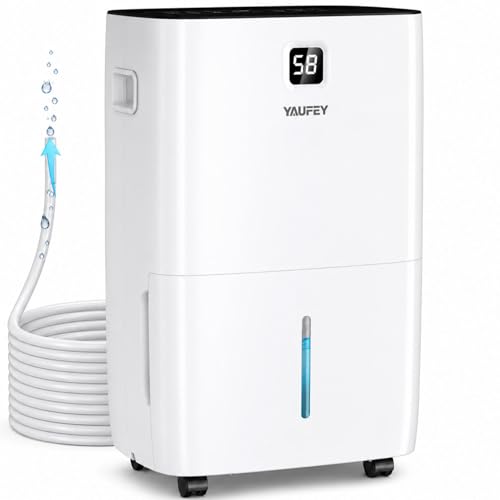
Yaufey 150 Pint Dehumidifier with Upward Drainage

PSOS Quiet Dehumidifier 98 OZ Water Tank

FreAire 34 Pint Dehumidifier with Drain Hose

QFOX 2000 Sq.Ft Rotary Dehumidifier 2.5L Tank

KNKA Energy Star 5500 Sq.Ft Dehumidifier

Yaufey 80 Pint Dehumidifier for Basement
Yaufey 120 Pint Dehumidifier for Basement
The Strengths Of Each Pick
When a basement smells like a wet towel and the carpet feels spongy underfoot, you need raw pulling power, not a desktop helper. The Yaufey 150 Pint Dehumidifier with Upward Drainage is built for that situation, rated to pull up to 150 pints per day and cover areas up to 8,500 square feet in extreme conditions. That ceiling is far above what most homes need, so it lands as overkill for a typical rec room and well-matched for a chronically damp foundation.
Three running modes give you a way to dial in aggressive drying, continuous operation, or a target humidity setpoint, and the upward drainage path lets a hose run out to a sink or floor drain without the unit sitting on a stand. Compared with the PSOS model below, this is a full-size compressor unit, meaning it works hardest in warm, damp conditions and slows down in a cold basement. Most homeowners with a moisture problem running 12 months a year will appreciate not having to babysit a tiny tank.
The Good Stuff
- Top-tier 150-pint extraction handles genuinely wet basements
- Upward drain routing simplifies hose runs to a floor drain
- Adjustable 30% to 80% humidity range in 5% steps
- Three operating modes let you match the drying job
Points To Note
- Compressor performance drops noticeably below about 65°F, so unheated spaces may need a heater helper
- Full-size footprint, so plan floor space near a drain
Right Fit For
Homeowners with a large, chronically damp basement and a floor drain nearby who want a set-and-forget compressor unit.
Where Another Pick Suits Better
The QFOX Rotary Dehumidifier makes more sense for an unheated garage or basement where compressor coils would frost up.
The PSOS Quiet Dehumidifier is a thermoelectric, or Peltier, style unit, meaning it uses solid-state cooling rather than a compressor, so there is almost no working hum. That makes it a natural fit for a nursery, small bedroom, or any room where a compressor drone would be a deal-breaker. The 98-ounce built-in tank is generous for the size, and an auto shut-off protects the unit when the tank fills.
Coverage tops out around 1,000 square feet, but in real bedrooms, bathrooms, and home offices the effective reach is much smaller, so you may find the sweet spot is a 200 to 400 square foot room. Seven ambient color lights sound like a gimmick, but they double as a low-level nightlight that some households genuinely appreciate. Compared with the Yaufey 150 pint model above, this trades raw extraction for quiet operation and a small desk-friendly footprint.
Practical Pluses
- Near-silent operation, suitable for sleeping spaces
- No compressor, so it weighs less and vibrates less
- Visible humidity readout takes the guesswork out of settings
- Tank auto shut-off prevents overflow spills
Honest Caveats
- Extraction rate is modest, so large or very wet rooms feel underpowered
- Tank needs manual emptying every few days in heavy use
Who It Suits Best
Apartment dwellers and light sleepers who want background moisture control in a single bedroom or small office.
Consider Something Else When
Step up to the FreAire 34 Pint if you need to dry a 1,500-plus square foot living area.
The FreAire 34 Pint Dehumidifier sits in the middle of the lineup, and that is exactly why it makes the shortlist. It pulls up to 34 pints per day under humid conditions, covers rooms up to 2,500 square feet, and ships with a 6.56-foot drain hose so you can route condensate to a sink or sump without lifting a tank. For a large open living area, a finished basement, or a master suite, that balance hits the mark.
The compressor is loud enough to notice on its highest setting but quiets down at lower fan speeds, so most people run it in a basement and forget it is there. Smart humidity control lets you set a target, and the unit cycles on and off to maintain it, which keeps electric use reasonable. Compared with the QFOX rotary model below, this one extracts faster in warm spaces but struggles in a cold basement, since compressor coils frost below roughly 65°F.
A Strong Showing
- 34-pint extraction covers most large rooms in real-world humidity
- Long drain hose included for hands-off water removal
- Target-humidity mode cycles the compressor efficiently
Small Caveats
- Compressor noise is noticeable at high fan speed
- Performance drops as room temperature falls, so unheated winter use is limited
Key Specs
Best Suited To
Homeowners with a large finished room or open floor plan who want a compressor unit without oversizing to a 50-pint model.
A Better Fit Elsewhere
The Yaufey 80 Pint is a smarter buy if you need to dry a full basement running 2,000-plus square feet.
The QFOX stands out for one big reason: it uses desiccant rotary technology, meaning it pulls moisture with a moisture-absorbing wheel rather than a compressor coil. That changes the math in unheated basements, garages, and RVs where temperatures drop below 65°F, since a compressor would frost up and shut off. The QFOX keeps working in cool spaces, which is the one weakness in every other pick on this list.
Daily extraction maxes out around 101 ounces, which is well below a 34-pint compressor unit in warm weather, but the trade is consistent output at any temperature. A 2.5-liter tank, sleep mode, drain hose, and seven-color ambient light round out the feature set. Compared with the PSOS model, the QFOX extracts more in real-world use and runs quieter than a compressor, though not silent.
Real-World Strengths
- Desiccant design keeps working in cool, unheated rooms
- Sleep mode drops noise and output for nighttime use
- Drain hose option removes the need to empty the tank
- Lighter and more portable than a compressor unit
Trade Offs
- Extraction volume is lower than a 34-pint compressor in warm, humid air
- Desiccant wheels usually need replacement every few years, adding long-term cost
Made For
Garage workshops, RVs, and unheated basements where a compressor would constantly cycle off due to frost.
Skip It When
The KNKA Energy Star is a stronger fit if your priority is low electric use in a large, warm basement.
The KNKA Energy Star 5500 Sq.Ft Dehumidifier is built for homeowners who care about long electric bills, not just daily extraction. It pulls up to 80 pints per day in humid conditions and covers areas up to 5,500 square feet, which is a comfortable match for a full basement under a mid-size home. Energy Star certification means the compressor and fan are tuned to draw less power per pint than non-certified units.
Smart humidity control, a sleep mode, and a continuous drain option put it in the same practical tier as the Yaufey 80-pint model below. The honest read is that the two units overlap heavily, and the deciding factor is often whichever is easier to find at the listing and which control panel you prefer. Either one handles a 2,000-plus square foot finished basement without running at full tilt all day.
Real Benefits
- Energy Star rating trims kilowatt-hour use compared to non-certified units
- 80-pint capacity covers most full basements comfortably
- Smart humidity control cycles the compressor efficiently
- Sleep mode quiets fan noise for nearby living spaces
Practical Considerations
- Compressor output drops as basement temperature falls below 65°F
- Energy savings versus a non-certified unit show up over months, not days
Feature Snapshot
Perfect Match For
Energy-conscious homeowners running a dehumidifier many hours a day in a finished basement.
Another Choice May Suit
The Yaufey 120 Pint is a smarter pick for a basement with serious standing-water history.
The Yaufey 80 Pint Dehumidifier for Basement is the workhorse most people actually need. It removes up to 80 pints per day, covers 5,000 square feet, and runs on an Energy Star certified platform, so it pulls moisture without punishing your electric bill. The included drain hose lets you plumb it to a floor drain, which is the real unlock: no more dragging a heavy tank across the basement every other day.
An adjustable 30% to 80% relative humidity range gives you fine control, and a 5% step interval keeps settings specific to the season. In our view, the best-fit basement for this unit is one with a finished floor plan, a sump or floor drain, and temperatures that stay above 65°F. If your basement runs colder, the QFOX above is the more honest match.
The Practical Payoff
- 80-pint capacity hits the sweet spot for most basements
- Energy Star rating keeps long-term electric use reasonable
- 5,000-square-foot coverage fits a mid-size home basement
- Continuous drain option eliminates tank emptying
Less Ideal Details
- Compressor frosts below about 65°F, so unheated basements need a heat source
- Air filter needs periodic rinsing to keep extraction at rated levels
Whose Shelf It Belongs On
Homeowners with a mid-size finished basement who want a long-running, low-touch compressor unit.
Where A Sibling Pick Shines
The Yaufey 120 Pint covers larger floor plans and is a better match for serious water intrusion.
The Yaufey 120 Pint Dehumidifier is the top of this Yaufey trio, extracting up to 120 pints per day in extreme conditions and covering up to 6,000 square feet. That is the unit you reach for when the basement has standing water history, after a sump pump replacement, or when a finished lower level needs consistent humidity control year-round. The Energy Star certification is the reason it lands in the premium tier rather than just the heavy-duty tier.
Like the 80-pint model, it includes a continuous drain hose and an adjustable humidity range. The honest read is that most homes do not need this much capacity, so it earns its place in shortlists for larger basements or homes with high occupancy. If your floor plan is below 3,000 square feet, the 80-pint is a more measured choice.
What Helps Most
- 120-pint extraction handles serious basement moisture loads
- 6,000-square-foot coverage fits large finished lower levels
- Energy Star platform keeps long operating hours affordable
- Continuous drain option means set-and-forget operation
Potential Compromises
- Overkill for small basements, so operating costs can run higher than needed
- Full-size chassis takes up significant floor space
Feature Rundown
Who Should Grab It
Homeowners with a large finished basement, high occupancy, or a history of standing water who want maximum certified extraction.
Not Your Match When
Pick the Yaufey 80 Pint for typical basement use, since the smaller unit covers the same role at lower operating cost.
What To Weigh Before Choosing A Dehumidifier
Matching a dehumidifier to a room is the single biggest decision. The same 80-pint unit that barely runs in a 4,000-square-foot basement will short-cycle and wear out fast in a 400-square-foot bedroom. Measure the actual square footage and use a conservative size match, since most homes run a dehumidifier in a smaller effective area than the rated coverage suggests.
Compressor versus desiccant is the second fork. Compressor units, like the Yaufey trio and the FreAire, extract faster in warm, humid air but slow down and frost in cool spaces. Desiccant rotary units, like the QFOX, work consistently in cold basements, garages, and RVs but produce less water per day. A thermoelectric unit, like the PSOS, is the quietest but covers the smallest rooms.
Look for continuous drain support if you want to forget about the unit. A built-in tank needs manual emptying every few days in heavy use, which becomes a chore fast. A drain hose, included with most of the basement-focused picks, routes water to a floor drain or sink so the dehumidifier runs without attention. Energy Star certification, on the KNKA and Yaufey 80 and 120 pint models, is worth the modest premium for long daily use.
Smart Buying Considerations Across These Picks
Common Shopping Slip Ups
The most common mistake is sizing by the room label rather than the actual moisture load. A “bedroom” that backs up to a damp exterior wall needs more capacity than an interior guest room of the same size. You may find that a 50-pint model outperforms a 30-pint one even in a smaller space when humidity is severe. Another trap is ignoring room temperature, since compressor units slow dramatically in unheated basements. Always check the rated operating temperature before buying.
Where The Extra Money Goes
Premium dehumidifiers, like the Yaufey 120 Pint and the KNKA Energy Star, cost more because they extract more water per kilowatt-hour. The Energy Star certification is not just a label, it reflects a compressor and fan design that has been independently tested for efficiency, which matters when a unit runs 10 to 16 hours a day. The upgrade also usually buys better filtration, quieter fans, and more reliable humidity sensors. The honest case for paying up is long daily runtime, while the case for a smaller unit is occasional use in a tight space.
Frequently Asked Questions
How many pints per day do you actually need?
A rough rule is to size at 10 to 15 pints per 1,000 square feet of damp space, with extra headroom in basements and laundry rooms. Oversizing shortens runtime, while undersizing keeps humidity stubbornly high.
Can a dehumidifier run 24 hours a day?
Most compressor and desiccant units are designed for continuous operation, with an auto defrost cycle for compressor models in cooler rooms. Just make sure the drain path is clear so the unit does not shut off when the tank fills.
Where should you place a dehumidifier?
Put it in the dampest part of the room, away from walls and furniture, with at least 6 to 12 inches of clearance for airflow. Basements benefit from a spot near a floor drain for easy hose routing.
Do dehumidifiers lower the room temperature?
Compressor models add a small amount of warmth to the air, often a few degrees, which is barely noticeable in a warm basement. Desiccant units add more heat and are best in cool spaces where that warmth is welcome.
How often does the filter need cleaning?
Most filters need a quick rinse every two to four weeks in heavy use, and a deeper wash every season. A clogged filter drops extraction performance and strains the compressor.
The Takeaway
The right dehumidifier is the one that matches your room, not the one with the biggest number on the box. For a small bedroom, a quiet Peltier unit is plenty. For a finished basement, an 80-pint Energy Star compressor is the honest daily workhorse. For a cold garage or RV, a desiccant rotary is the only real answer. Start with the room, then pick the technology, and the price tiers fall into place on their own.