

A damp basement does more than smell off. Moisture quietly feeds mold, warps floor joists, and turns stored cardboard into mush. Portable air conditioner dehumidifiers that actually pull serious pints per day change that math fast, and the seven models below are built for the wettest corners of a home.
A Snapshot Of The Selections

ALORAIR 70 PPD Dehumidifier with Pump for Crawl Space and Basement

ALORAIR 120 Pints Energy Star Crawlspace Dehumidifier with Pump

ALORAIR 198 Pints Crawlspace Dehumidifier, Sentinel HD90

ALORAIR 120 Pints Energy Star Crawlspace Dehumidifier, Sentinel HD55S

ALORAIR 70 Pints Crawlspace Dehumidifier, Sentinel HS35
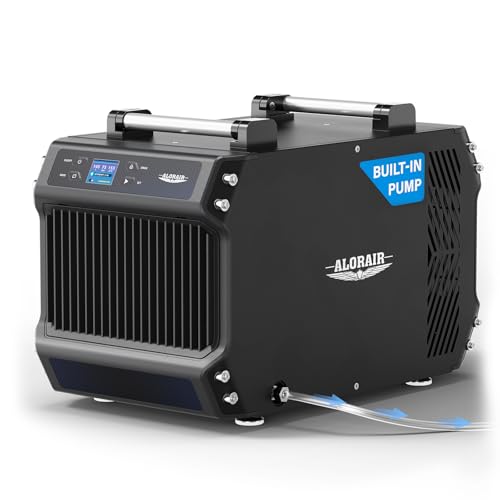
ALORAIR 145 Pints Crawlspace Dehumidifier with Pump, Galaxy 60P

ALORAIR 70 Pints Energy Star Crawlspace Dehumidifier
A Breakdown Of The Leading Choices
This ALORAIR 70 PPD unit is the kind of workhorse you drop in a basement and forget about, assuming you run the included drain hose to a floor drain or condensate outlet. Rated at 35 pints per day under AHAM conditions (a standardized test of 80°F and 60% relative humidity used to measure moisture removal, the industry benchmark for fair comparison) and 70 pints at saturation, it covers up to 1,000 square feet, which fits most single-zone basements.
Automatic defrost lets the coils keep working as temperatures dip, while memory start brings the unit back to its last setting after an outage, useful in spaces where the breaker occasionally trips. The onboard pump pushes condensate upward and sideways, so a gravity drain is not always required.
Positive Takeaways
- Built-in pump pushes water where gravity cannot, simplifying installs in basements with no floor drain.
- Auto-defrost keeps extraction steady in cooler crawlspaces that would stall lesser units.
- Memory start restores settings after power loss, helpful in older electrical setups.
- cETL listing signals independent electrical safety certification, a meaningful mark in damp locations.
Worth Noting
- At 70 pints saturation, the unit sits in a mid-tier capacity range, so very wet commercial spaces may outgrow it.
- Drain hose setup requires routing planning before the first run, and kinks in the line can stop the pump.
Who It Suits Best
Homeowners with a 1,000 square foot basement and a nearby drain point who want a set-it-and-forget-it install.
Consider Something Else When
The ALORAIR 120 Pints Energy Star Crawlspace Dehumidifier with Pump is the better call for larger or chronically saturated basements.
The 120 Pints Energy Star model targets the upper end of typical residential demand. It pulls up to 120 pints per day at saturation, with 55 pints at the AHAM baseline, and covers up to 1,300 square feet. The Energy Star rating matters for anyone planning to run a unit 24/7 in a finished basement.
Like the 70 PPD unit above, it includes a built-in pump and a metal outer casing that tolerates crawlspace dust and the occasional bump. Where it diverges is raw capacity, which makes a real difference in regions with high groundwater tables.
What Helps Most
- Energy Star efficiency trims long-term power costs, a meaningful factor for always-on installations.
- 120-pint saturation rating tackles chronic dampness that overwhelms 70-pint models.
- Metal casing holds up to crawlspace dust and minor impacts better than plastic housings.
Trade Offs
- Larger footprint than compact units, so tight crawlspace returns require planning clearance.
- Higher upfront cost may not pencil out for occasional-use basements.
Key Specs
Made For
Owners of mid-to-large basements in humid climates who run a dehumidifier year-round and care about electricity costs.
Look Elsewhere When
The ALORAIR 198 Pints Crawlspace Dehumidifier, Sentinel HD90 fits commercial-scale or water-damage restoration environments.
The Sentinel HD90 is a different animal. At 198 pints per day saturation and 90 pints at AHAM, it pushes into commercial territory, and the 2,600 square foot coverage rating confirms it. Compared to the 70 PPD unit, the HD90 is roughly twice the machine, built for restoration contractors and very large damp spaces.
An R32 refrigerant system (a newer, lower-global-warming-potential refrigerant that also tends to perform efficiently across a wide temperature range) supports the higher output while keeping the unit relatively compact. Carry handles on the chassis acknowledge the extra weight.
The Good Stuff
- 198-pint saturation output handles standing-water-adjacent humidity that stalls residential units.
- R32 refrigerant is more efficient and carries a lower environmental footprint than older R410A systems.
- Integrated carry handles offset the heavier chassis for repositioning on job sites.
Honest Caveats
- Overkill for typical residential basements, where the 120-pint model would already exceed needs.
- Higher noise output in continuous operation, a common trait of large-capacity compressors.
Right Fit For
Restoration professionals and owners of very large, chronically damp commercial or semi-commercial spaces.
Another Choice May Suit
The ALORAIR 145 Pints Crawlspace Dehumidifier with Pump, Galaxy 60P is a better residential balance for most homeowners.
The Sentinel HD55S is the older sibling to the current 120 Pints Energy Star model above, and it shares most of the same DNA: 55 AHAM pints, 120 saturation pints, and 1,300 square foot coverage. Where it stands apart is the rugged metal housing designed for demanding environments over many years of service.
For homeowners who want proven longevity rather than the latest casing design, the HD55S is the established choice. It suits warehouses, offices, factories, and basements where the unit will simply run and run.
Benefits That Matter
- Time-tested chassis built for continuous duty in commercial environments.
- Energy Star efficiency keeps operating costs manageable on a 24/7 schedule.
- 120-pint capacity handles most residential and light commercial demands.
Points To Keep In Mind
- Heavier than plastic-housed competitors, so plan for two people during installation.
Feature Snapshot
Who Should Grab It
Owners who prioritize proven reliability and a metal housing over the newest cosmetic design.
Skip It When
The ALORAIR 70 PPD Dehumidifier with Pump makes more sense in smaller basements where maximum capacity is not needed.
The Sentinel HS35 is the lighter, more portable sibling in the 70-pint family. It removes 35 pints per day at AHAM, up to 70 at saturation, and the chassis is built for repositioning rather than permanent mounting. With 115 CFM airflow (cubic feet per minute, a measure of how much air the unit can circulate, and a key indicator of how quickly it can treat a room), it covers up to 1,000 square feet.
The compact form factor is the main story. It tucks into tight crawlspace returns or closet installations where larger units simply do not fit.
Useful Touches
- Compact and lightweight for a 70-pint unit, easier to carry into tight access points.
- 115 CFM airflow moves air efficiently through smaller spaces.
- Versatile placement across crawlspaces, bathrooms, bedrooms, and closets.
Some Limits To Know
- No built-in pump, so a gravity drain or manual emptying is required.
- 1,000 square foot ceiling is lower than larger 1,300+ sq ft options.
Best Suited To
Smaller basements, bathroom renovations, and homeowners who need to move a unit between locations.
Reach For A Different Pick When
The ALORAIR 70 PPD Dehumidifier with Pump is a stronger fit for permanent basement installs that benefit from pump-driven drainage.
The Galaxy 60P carves out a middle ground between the 120 and 198-pint commercial options. At 145 pints per day saturation and 1,800 square foot coverage, it fits spaces that are too damp for a 120 but do not need the full HD90. Like the 70 PPD model, it ships with a drain hose for long-distance condensate routing.
The pump-driven drainage and wide coverage make it a natural fit for large open basements, garage conversions, and storage areas where a single unit needs to handle a broad footprint.
Key Advantages
- 145-pint saturation output sits in a useful gap between residential and commercial models.
- 1,800 square foot coverage handles open-plan basements with one unit.
- Pump-equipped design supports long drain runs to a sump or utility sink.
Where It Is Less Suited
- Diminishing returns in basements under 1,000 square feet, where a 70-pint unit is more efficient.
Feature Rundown
Whose Shelf It Belongs On
Owners of large basements, garage conversions, or storage areas needing a single high-capacity unit.
Where A Sibling Pick Shines
The ALORAIR 198 Pints Crawlspace Dehumidifier, Sentinel HD90 is the better tool for true commercial or restoration use.
This 70 Pints Energy Star model rounds out the list as the efficiency-focused alternative to the 70 PPD pump version above. It pulls the same 35 AHAM pints and 70 saturation pints across 1,000 square feet, but the Energy Star rating lowers electricity draw, a meaningful factor for always-on basement duty.
A MERV-1 filter (a minimum efficiency reporting value rating that measures how well a filter captures particles, with higher numbers capturing smaller particles) traps up to 95% of pollutants down to 10 microns, enough to reduce dust load on internal components and keep the air cleaner in living-adjacent basements.
Practical Pluses
- Energy Star efficiency cuts long-term operating costs for continuous basement operation.
- Built-in filter reduces dust on internal components, extending service life.
- Auto-defrost and memory restart make unattended use reliable.
Small Caveats
- No onboard pump, so a gravity drain is necessary, which limits placement flexibility.
Perfect Match For
Homeowners with a 1,000 square foot basement who prioritize low electricity costs and a maintenance-friendly filter.
Swap It Out When
The ALORAIR 70 PPD Dehumidifier with Pump fits better if your install lacks a gravity-friendly drain path.
Choosing The Right Capacity For Your Space
Capacity claims come in two flavors, and mixing them up is the most common mistake in this category. AHAM pints per day is the honest baseline measured at 80°F and 60% relative humidity; saturation pints per day is the higher marketing number measured in extreme conditions. For a real basement, AHAM pints are the figure that matches lived experience.
Square footage ratings assume standard ceiling height and moderate humidity. Taller ceilings, open stairwells, and persistent groundwater seepage push a unit harder than the rating suggests, so sizing up is reasonable when the space is borderline.
Pump versus gravity drainage is the other fork. Units with built-in pumps push condensate upward and across longer distances, which matters in basements without a floor drain. Gravity-drain models are simpler, but they need a downhill path and a nearby drain point.
Finally, build quality shifts based on installation environment. Metal housings survive crawlspace dust and accidental contact, while plastic housings are lighter and easier to carry but show wear sooner. Energy Star ratings matter for any unit running more than a few hours a day.
Key Considerations Across These Picks
Pitfalls Shoppers Hit
The single biggest trap is buying on saturation pints alone. A 198-pint unit looks compelling next to a 70-pint model, but if the actual humidity is moderate, the smaller unit will do the same job for less money and electricity. The reverse mistake, buying a 70-pint unit for a chronically wet basement, leaves the compressor running nonstop without ever catching up.
Another common miss is ignoring drain logistics. A unit without a pump can sit exactly where you need it, until the condensate hose has nowhere to drain. Measure the path before you commit.
When Paying More Pays Off
Higher-tier models earn their premium through pumps, larger coils, and more efficient compressors. The jump from a 70-pint gravity-drain unit to a 120-pint pump-equipped Energy Star model is often the sweet spot for homeowners, because the pump removes the drain-location constraint, and the efficiency rating pays back over years of continuous use.
Frequently Asked Questions
How many pints per day do I actually need?
Start with AHAM pints, not saturation numbers. For a 1,000 square foot basement with moderate humidity, a 35 to 55 AHAM pint unit is a sensible baseline. Chronic dampness or commercial-scale spaces push that toward 90 AHAM pints or higher.
Do I need a built-in pump?
A pump is essential when no floor drain or downhill drain path is available. Without one, you will empty a collection tank or route a gravity hose across the basement, both workable but less convenient.
Can one unit cover a whole basement?
Coverage ratings assume a single open zone. Finished basements with closed-off rooms often need a second unit, or strategic door positioning to let airflow circulate.
What about noise?
Compressor noise varies by capacity, and larger units tend to run louder. Place the unit on a rubber mat or foam pad to reduce vibration transfer into living space above.
Is Energy Star worth the premium?
For units running 12 or more hours daily, Energy Star efficiency pays back the cost difference in electricity savings, often within a few years of continuous operation.
Closing Remarks
The right unit depends less on maximum capacity and more on your basement’s drain layout, ceiling height, and how often the unit actually runs. Match the AHAM rating to your space, decide on pump versus gravity, and let Energy Star guide you when runtime is high. Any of the seven models above will do honest work; the differences come down to fit, not quality.