


Indoor air shifts more than most people notice, and a dry winter bedroom or a muggy basement can quietly damage wood floors, musical instruments, baby skin, and stored wine. Mini-hygrometers put that invisible data on a small screen or in an app so you can react before problems show up. This roundup focuses on compact, accurate sensors that suit real homes, whether you want a simple readout or a whole-house network. The picks below balance precision, connectivity, and value across six solid options.
The Main Contenders

GoveeLife 2.0 WiFi Hygrometer Thermometer with Gateway, Mini Sensor 3-Pack

GoveeLife Bluetooth Thermometer Hygrometer H5220, Large LCD Display 1-Pack

TempPro TP49 4 Pack Digital Hygrometer Indoor Thermometer

GoveeLife 2.0 WiFi Hygrometer Thermometer with Gateway, Mini Sensor 6-Pack

DOOMAY Hygrometer, Indoor Temperature Humidity Monitor for Nursery
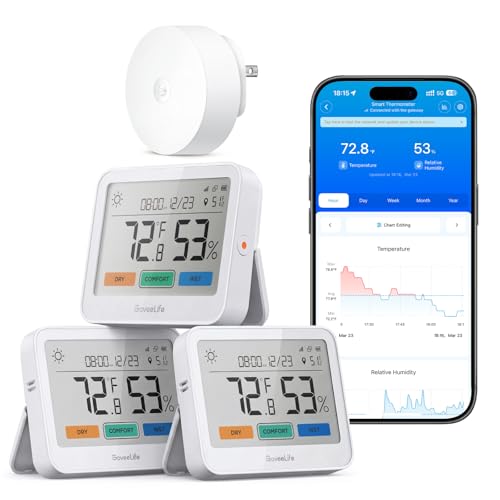
GoveeLife WiFi Thermometer Hygrometer 5-in-1, Large LCD 3-Pack with Gateway
A Closer Look At Each Pick
The GoveeLife 2.0 WiFi Hygrometer Thermometer with Gateway, Mini Sensor 3-Pack is built for people who want a connected reading in multiple rooms without juggling separate displays. Each mini sensor is small enough to slip onto a shelf, wine rack, or greenhouse bench, and a single gateway (a small bridge that links the wireless sensors to your home network) talks to all of them through a 2.4 GHz Wi-Fi connection.
The Swiss-made sensor inside each unit is a higher-grade component than what you typically see at this size, which is one reason owners tend to trust the long-term numbers. Compared with the simpler single-unit options later in this list, the gateway approach makes sense once you care about more than one room at a time.
Practical Advantages
- Swiss-grade sensor with ±0.54°F (±0.3°C) and humidity accuracy to within roughly 3 percent for more reliable numbers
- Single gateway links up to 10 sensors, so a three-pack can grow into a full-home system over time
- App alerts when temperature or humidity drifts out of range, handy for wine cellars and basements
- Two-year battery life on each mini sensor reduces the annoyance of constant battery swaps
Trade Offs
- 2.4 GHz Wi-Fi only, so dual-band routers without that band active will need a settings check
- You depend on the gateway staying powered and online; if it goes down, the sensors can’t push data to your phone
Who It Suits Best
Homeowners with a wine cellar, finished basement, or multiple rooms to monitor who want app-based alerts rather than just a small screen on each device.
Look Elsewhere When
The GoveeLife Bluetooth Thermometer Hygrometer H5220 makes more sense for a single bedroom or office where a gateway setup feels like overkill.
The GoveeLife Bluetooth Thermometer Hygrometer H5220, Large LCD Display 1-Pack trades app complexity for a big, readable screen and a Bluetooth connection. It pairs to your phone only when you open the app, so there is no constant background data drain. The device displays temperature, humidity, trend arrows, and a comfort indicator on one large LCD panel.
For someone who wants a glanceable reading on a desk or nightstand without a full smart-home setup, this sensor is a low-fuss option. The 196-foot open-air Bluetooth range is generous for a small apartment, though walls will reduce that in practice. It is the polar opposite of the gateway-driven three-pack above, which is precisely why it earns its spot here.
The Practical Payoff
- Large LCD that reads clearly from across a small room or from a bedside position
- Bluetooth pairing uses less power than a constant Wi-Fi connection, so batteries tend to last longer in practice
- Single device, no gateway needed, which keeps the setup minimal for renters or first-timers
Small Caveats
- No continuous remote monitoring without a separate gateway accessory
- Single unit only, so covering several rooms means buying multiples without a unifying hub
Made For
One room, one person, one clean readout on a desk, dresser, or nursery shelf without the maintenance of a hub.
Skip It When
The GoveeLife 2.0 WiFi Hygrometer Thermometer with Gateway, Mini Sensor 3-Pack fits better once you want readings from a wine cellar, basement, and bedroom at the same time.
The TempPro TP49 4 Pack Digital Hygrometer Indoor Thermometer gives you four standalone units in one box, which is the core appeal. Each display reads temperature and humidity and adds a face-style comfort indicator that quickly tells you whether the air is dry, comfortable, or wet. For greenhouses, reptile rooms, or a multi-room home, four sensors at this tier is genuinely practical.
The sensor accuracy is rated at ±1°F/°C and roughly ±2 to 3 percent relative humidity, which is the kind of tolerance most households need. Where the TempPro differs from the GoveeLife picks is the absence of any wireless connection. You walk up and read the screen. For many users, that simplicity is the point.
Where It Excels
- Four units per pack covers a whole house, small greenhouse, or classroom at a low per-unit cost
- Comfort face icon makes at-a-glance decisions quick for non-technical users
- Acceptable accuracy for monitoring dynamic spaces like plant rooms and wine storage
Honest Caveats
- No app or wireless connectivity, so historical tracking requires manual logging
- Small display, harder to read from across a room compared with the GoveeLife H5220
Best Suited To
Budget-conscious households or plant and pet owners who want a sensor in every relevant room without paying for smart features they will not use.
Another Choice May Suit
Pick the DOOMAY Hygrometer, Indoor Temperature Humidity Monitor for Nursery instead if you need manual calibration to align readings between rooms.
The GoveeLife 2.0 WiFi Hygrometer Thermometer with Gateway, Mini Sensor 6-Pack is essentially the three-pack at double the coverage. The same Swiss-grade sensor and gateway architecture handle up to 10 sensors total, so you start with six and have room to expand. The mini format means each unit disappears into a room.
This is the kit for a property where one room is not enough. A finished basement plus a wine cellar plus a nursery plus an attic plus a greenhouse plus a garage becomes a real, monitorable network, all visible in the same app. The trade-off is the upfront cost, which is higher than four standalone TempPro units but comes with the connectivity those lack.
The Good Stuff
- Six sensors cover most homes out of the box, with room to scale up to 10 on the same gateway
- App-based alerts, two-year data logging, and remote monitoring from anywhere with a phone signal
- Identical accuracy to the three-pack, so adding more sensors does not reduce precision
Points To Note
- Higher initial outlay than standalone sensor packs
- Limited to 2.4 GHz Wi-Fi, which can be a friction point on some mesh systems
- More sensors mean more batteries to track over time, even with the two-year lifespan
Who Will Love This
Larger households, multi-story homes, and anyone managing a cellar, attic, and workshop who wants every space on one dashboard.
A Better Fit Elsewhere
Reach for the GoveeLife WiFi Thermometer Hygrometer 5-in-1, Large LCD 3-Pack with Gateway if you prefer a large on-device screen and fewer sensors.
The DOOMAY Hygrometer, Indoor Temperature Humidity Monitor for Nursery is aimed at parents who want reliable readings in a single space where consistency matters. Two features stand out: a manual calibration function that lets you offset the reading by ±5°C or ±10% relative humidity, and a 24-hour max/min tracker that resets at midnight.
That calibration is genuinely useful. Two sensors in the same room sometimes show slightly different numbers, and being able to nudge a unit into alignment with a known reference helps you trust the data. Compared with the GoveeLife H5220 above, the DOOMAY has no Bluetooth, so you read directly from the device rather than the phone.
Real-World Strengths
- Manual calibration helps when matching the reading to a trusted reference sensor elsewhere in the home
- 24-hour max/min tracking shows the swing in nursery conditions overnight
- Compact design fits on a changing table or shelf without taking up usable space
Less Ideal Details
- No wireless connectivity, so logging requires checking the device in person
- Single-sensor format, so additional rooms need additional units purchased separately
Perfect Match For
New parents setting up a nursery who want a single trustworthy readout and the ability to calibrate if a second meter disagrees.
Where Another Pick Suits Better
The GoveeLife Bluetooth Thermometer Hygrometer H5220 fits better if you want phone access to the nursery reading from another room.
The GoveeLife WiFi Thermometer Hygrometer 5-in-1, Large LCD 3-Pack with Gateway is the most data-forward option in this roundup. Each unit shows temperature, humidity, trend data, a color-coded comfort indicator, and the local weather forecast, with the gateway extending the working range up to 1,640 feet in open air. That is a meaningful reach upgrade over the basic Bluetooth range of the H5220.
The 5-in-1 reading approach means less switching between the unit and your phone. The on-device display handles quick checks, while the app handles history and alerts. This sits between the minimalist three-pack and the large six-pack covered earlier: same Wi-Fi ecosystem, fewer sensors, but a richer on-device interface per unit.
Strengths Worth Knowing
- 1,640-foot open-air gateway range handles thick walls, basements, and detached buildings more reliably
- Color-coded comfort indicator and forecast on the unit itself, so you do not need the app for quick reads
- Three large-LCD units provide strong at-a-distance visibility alongside full app integration
Points To Keep In Mind
- Fewer sensors than the six-pack at a comparable per-unit cost in many cases
- Best feature set requires the gateway to stay powered and within range, so placement matters
Whose Shelf It Belongs On
Data-driven homeowners who want on-device clarity and app history in equal measure, especially in spaces where thick walls challenge simpler wireless setups.
Consider Something Else When
Pick the TempPro TP49 4 Pack Digital Hygrometer Indoor Thermometer for straightforward multi-room coverage without the gateway and app overhead.
Picking the Right Mini-Hygrometer for Your Space
The right sensor starts with the question of how many rooms you want to watch. A single bedroom or nursery calls for a one-unit display like the DOOMAY or the GoveeLife H5220, where glanceable readouts matter more than app alerts. Multi-room coverage shifts the math toward packs like the TempPro TP49 four-pack or one of the GoveeLife gateway kits, which let you monitor a wine cellar, basement, and living area from the same dashboard.
Connectivity is the second fork in the road. Pure standalone units keep things simple and battery-friendly, but lose remote alerts and historical graphs. Bluetooth-only devices add app access when you open the app, which is plenty for many households. Wi-Fi gateway systems cost more and depend on a hub, but they push continuous data, send alerts when humidity drifts, and survive thick walls much better than Bluetooth alone.
Accuracy tolerance is the final filter. The GoveeLife Swiss-grade sensor specifies tighter tolerances for both temperature and humidity than the typical digital hygrometer, which matters for wine storage, cigar humidors, and instrument rooms where a few percentage points can affect the contents. For general comfort monitoring, the wider tolerance of budget sensors is rarely a problem.
What Sets These Six Picks Apart
Mistakes Worth Dodging
A common slip is buying a single high-end sensor and expecting it to tell you about the whole house. Indoor humidity varies room to room because of sunlight, ventilation, and moisture sources, so one reading in the living room tells you very little about the bathroom or the basement. Multi-point coverage is the only way to see the full picture.
Another trap is ignoring the Wi-Fi band requirement. Many recent mesh routers steer devices to 5 GHz or 6 GHz bands by default, and a 2.4 GHz-only sensor can struggle to join. Checking router settings before buying a Wi-Fi gateway kit saves a return trip later.
When Paying More Pays Off
Higher-tier models in this category generally buy three things: tighter sensor accuracy, gateway-based long-range connectivity, and richer on-device displays. The upgrade is worth it when the room you monitor actually matters, like a wine cellar, a humidor, or a nursery where a reading off by a few percent could affect a baby or a collection. For a general sense of whether the bedroom feels stuffy, a budget four-pack does the same job.
Frequently Asked Questions
How accurate are mini-hygrometers in real homes?
Most consumer units land within a few percentage points of true humidity once acclimated, and the Swiss-grade sensors in the GoveeLife gateway kits narrow that further. Placing the sensor away from direct sunlight, drafts, and walls gives the most reliable numbers.
Do I need a Wi-Fi gateway or is Bluetooth enough?
Bluetooth works for one or two rooms where you check the app on the same device, while a Wi-Fi gateway supports more sensors, longer range, and remote alerts from anywhere. Multi-room and detached-space setups benefit more from the gateway approach.
Where should I place a mini-hygrometer for the best reading?
Keep the sensor out of direct sunlight, away from heating vents, and roughly at breathing height for the space. A wall-mounted position away from windows tends to track the actual room air rather than a boundary layer.
Can one gateway support sensors in multiple buildings?
Yes, the open-air range on the GoveeLife gateway units is rated up to 1,640 feet, which can cover a detached garage or workshop in many layouts. Walls, metal roofing, and distance will reduce that real-world range considerably.
How often do the batteries need changing?
Standalone units and Bluetooth sensors often run a year or more on a single set, while the GoveeLife Wi-Fi mini sensors are rated for roughly two years. Heavy app polling, low-quality batteries, or cold environments can shorten that span.
Closing Remarks
A good mini-hygrometer turns invisible air into a number you can act on, and the right pick depends entirely on how many spaces you want to watch and how connected you want the data to be. Start with the room that matters most, then build out from there.