


A dry house wrecks sleep, cracks wood floors, and turns plants into crispy shadows. Choosing the right humidifier for a large open-plan area, a multi-room layout, or a basement workshop means matching tank size, mist output, and coverage to the actual square footage. This roundup walks through eight strong options, from whole-house furnace units to smart consoles, so you can find a humidifier that fits your space without guesswork.
A Side-By-Side Look

LRAZU Cool Mist Humidifier Large Room 15L

AprilAire 600M Whole-House Humidifier
Lacidoll Humidifier Large Room 26L/6.8Gal
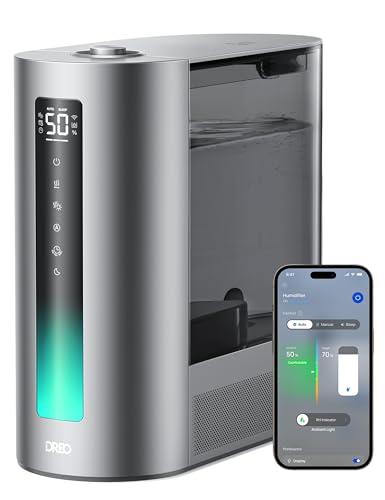
DREO 6L Smart Humidifier Warm & Cool Mist
LACIDOLL Humidifier Large Room 26L/6.8Gal

DREO 11L Smart Humidifier 747S

DREO 6L Smart Humidifier 60H Runtime
Lacidoll Humidifier 25L/6.6Gal Top-Fill with Extension Tube
The Picks, Examined More Closely
The LRAZU 15L sits in a useful middle ground between compact bedside units and the heaviest commercial gear. A 15-liter (3.96-gallon) tank paired with a 350 mL/h spray rate is genuinely suited to open living areas, and the listed coverage of roughly 800 square feet handles a generous main floor in most homes.
You also get five mist levels, so the same unit works in a drafty living room at full power and tones down nicely for a quiet night in the den. For anyone running a small business out of a home office or trying to keep a workshop from drying out, the tank capacity cuts refill trips down to a few times a week rather than daily.
The Case For It
- 15-liter capacity supports extended runtime between refills, helpful in busy households.
- Five mist settings give you granular control instead of a single fixed output.
- 800 sq ft coverage suits open-plan living areas and combined living-dining spaces.
- Cool-mist ultrasonic (uses high-frequency vibration to produce a fine, cool fog) operation is generally quiet enough for a TV room or shared bedroom.
- Adjustable humidity target (40 to 90 percent) lets the unit self-regulate rather than run continuously.
Things To Consider
- Tank size means refills are heavier, so a nearby sink or a pitcher routine helps.
- Ultrasonic units commonly need routine cleaning to prevent mineral buildup in hard-water areas.
Best Suited To
Large open-plan homes and small offices that want long runtimes without daily refills.
Look Elsewhere When
You want a fully hands-off furnace-mounted install, in which case the AprilAire 600M makes more sense.
The AprilAire 600M is a different kind of product. Rather than a portable console, it mounts directly onto your furnace ductwork and treats the entire forced-air system as a single distribution network. With a 17-gallon-per-day capacity and coverage up to 5,000 square feet in tightly built homes, it is built for people who want to stop thinking about humidity.
You do get a manual control with a single built-in sensor, so you set a target and the unit takes over. If you live in a climate where winter air turns the house into a static-charge zone, this is the most comprehensive approach on the list, and it does the work of a portable unit times three without taking up floor space.
A Few Strong Suits
- Whole-house coverage up to 5,000 sq ft replaces several portable units.
- 17 gallons per day output handles dry winter climates without falling behind.
- Single-sensor manual control is straightforward, with no app to configure.
- Evaporative design (pulls air through a moistened pad, which limits mineral dust) suits households worried about white residue.
- Once installed, the unit is largely invisible and very quiet since there is no fan of its own.
Trade Offs
- Installation is not casual. You need access to the supply plenum and a drain line.
- The pad and water panel need seasonal replacement, adding to ongoing ownership effort.
- You will not get the portability of the LRAZU or DREO units if you want room-to-room flexibility.
Made For
Homeowners in cold, dry climates who want a permanent, whole-house solution tied into the HVAC system.
Skip It When
You rent, lack attic or basement HVAC access, or simply want a plug-and-play console, in which case the LRAZU 15L is the easier start.
Where the LRAZU handles a living room, the Lacidoll 26L starts looking more like shop equipment. The 6.8-gallon tank and 1,800 mL/h maximum mist output, paired with claimed coverage up to 3,000 square feet, push it well past a typical residential console.
It earns that “workshop” tag for a reason. A home studio, finished basement, or garage gym with high ceilings will drink through smaller units in a single afternoon. The Lacidoll keeps going, and the cool-mist ultrasonic design runs without a heating element, which keeps power draw modest compared to warm-mist or steam alternatives.
Points In Its Favor
- 26L capacity means real multi-day runtime, which matters when the unit is not easy to reach.
- 1,800 mL/h output recovers humidity quickly in big open spaces.
- 3,000 sq ft coverage dwarfs most consumer consoles on this list.
- Cool-mist operation is safe around curious kids and pets since there is no heating element.
Honest Caveats
- Footprint is substantial, so plan a corner with a nearby outlet before unboxing.
- Tank refills are heavy, and a small utility sink or floor drain makes life easier.
- Not designed for whisper-quiet bedrooms. You will hear a low ultrasonic hum up close.
Right Fit For
Shop owners, hobbyists, and homeowners with oversized rooms that outgrow standard 6-liter consoles.
Reach For A Different Pick When
You mostly want bedroom-level quiet, in which case the DREO 11L Smart Humidifier 747S is a better match.
The DREO 6L earns its spot because it does something most units on this list do not: it produces a warm mist on demand. The internal heater pushes output up to 133 degrees Fahrenheit, and the manufacturer says you see visible mist within about five minutes, which is genuinely useful in a cold bedroom on a January night.
Coverage tops out around 550 square feet, so this is not the unit to humidify a barn. But for a primary bedroom or a nursery where you want a warm, comforting atmosphere rather than a cool fog, the dual-mode design is a real differentiator compared to the LRAZU cool-only setup.
Everyday Wins
- Warm-mist mode is a tangible comfort upgrade in cold climates and helps the room feel less drafty.
- Cool-mist option keeps the unit useful in shoulder seasons when you do not want extra heat.
- 6L tank is a manageable size for a bedroom without dominating floor space.
- App-based control removes the need to get out of bed to tweak settings.
Some Limits To Know
- 550 sq ft coverage is fine for a bedroom but small for a true whole-home solution.
- Warm-mist mode draws more power than a cool-only unit, worth noting on a tight electrical circuit.
Who It Suits Best
Anyone who runs a cool bedroom in winter and wants a humidity boost that also feels physically warming.
Not Your Match When
You need to cover a sprawling open-plan area, in which case the Lacidoll 26L or AprilAire 600M is the better match.
This Lacidoll shares the 26L tank and 1,800 mL/h output of its sibling above, so the case for ownership overlaps heavily. The difference shows up in fit. Where the earlier Lacidoll positions itself as a flexible household-plus-workhorse unit, this version leans further into the commercial-and-industrial framing, with the same 3,000-square-foot ceiling coverage.
For an office, a light-industrial space, or a sizeable greenhouse, that kind of overhead matters. You can run the unit hard for a working day, drain it, and move on. It is overkill for a one-bedroom apartment, and the lack of smart features will not bother a warehouse manager the way it might a homeowner building a connected home.
The Upside
- Top-tier output per dollar compared to smaller residential units.
- Coverage handles large open offices and warehouse sections without dead zones.
- Filter-free design lowers the long-term cost of consumables.
- Ultrasonic cool-mist design is energy-efficient relative to steam alternatives.
Worth Noting
- Footprint and weight mean this is not a “tuck it in a corner” piece of furniture.
- No smart connectivity, so all adjustments happen at the unit itself.
Perfect Match For
Facility managers and home growers running spaces that demand serious, sustained output.
Where Another Pick Suits Better
For a smart-home setup with voice and app control, the DREO 6L 60H is a friendlier daily driver.
The DREO 747S trades some of the Lacidoll’s raw output for a much more residential feature set. The 11-liter tank supports up to 100 hours of runtime at lower settings, and DREO publishes a 21 dB noise figure, which for context is roughly the level of a quiet library, so this is a unit you can park next to a bed without resentment.
You also get a roughly 6-foot-tall mist plume, which helps the moisture reach further before settling. Coverage up to 700 square feet covers a large primary bedroom, a den, or a home office comfortably, and the smart features tie it into the same app as the other DREO units on this list.
What Makes Sense
- 21 dB noise level is a real sleep-friendly spec, not a marketing number.
- 100-hour runtime on low reduces refill frequency to roughly weekly for many bedrooms.
- Tall mist plume improves distribution in rooms with high ceilings.
- 11L capacity strikes a useful middle ground between compact 6L and bulky 26L units.
Points To Keep In Mind
- 700 sq ft coverage trails the Lacidoll units by a wide margin.
- Smart features assume a stable Wi-Fi connection and a willingness to fiddle with an app.
Whose Shelf It Belongs On
Light sleepers, shift workers, and anyone who wants a quiet bedroom unit with serious staying power.
Swap It Out When
You need to cover a workspace or warehouse. The LACIDOLL 26L has the muscle for that scenario.
Where the 747S emphasizes raw runtime, this 6L DREO leans into connectivity. The built-in humidity sensor, app control, and voice compatibility let you adjust mist levels from another room or another city, which sounds trivial until you have a snoring partner and do not want to walk across the house to silence a chirping unit.
Capacity is smaller at 6 liters, so the 60-hour runtime figure assumes lower-output settings, but the trade-off is a unit that disappears on a side table. The 28 dB noise level is slightly louder than the 747S but still well below typical conversation, fine for most bedrooms.
A Few Highlights
- Next-gen sensor plus auto mode keeps humidity within a tight band without manual tweaks.
- App and voice compatibility integrate with existing smart-home routines.
- 6L size is genuinely portable, useful in a guest room you only heat seasonally.
- Quiet 28 dB operation will not disturb a bedside conversation or a Zoom call.
Where It Is Less Suited
- 6L tank is not the right tool for a great room or a large open-plan layout.
- Smart features add setup time, so the unit is not ideal for non-tech-comfortable households.
Who Should Grab It
Connected-home enthusiasts who want humidity tied into routines and voice control, not a standalone appliance.
A Better Fit Elsewhere
For sheer bedroom quietness, the DREO 11L Smart Humidifier 747S is the stronger choice.
The third Lacidoll in this list earns its place with two practical upgrades. First, the top-fill design removes the upside-down tank shuffle that makes bottom-fill humidifiers feel like an upper-body workout. Second, the included extension tube plus a 360-degree nozzle lets you direct mist toward a plant shelf, a propagation tent, or a specific corner of a greenhouse.
Underneath, the 25L (6.6-gallon) tank with up to 2,000 mL/h output and 3,000-square-foot coverage is in the same commercial-grade neighborhood as its Lacidoll siblings. For anyone whose humidity needs revolve around tropical plants as much as people, this is the most purposeful design on the list.
Practical Pluses
- Top-fill access saves a real amount of effort when refilling weekly.
- Extension tube and 360-degree nozzle deliver mist where plants actually sit, not just the open air.
- Filter-free design reduces recurring cost and ongoing maintenance.
- 2,000 mL/h output is the highest figure on this list, recovering humidity fast in big rooms.
Practical Considerations
- Tank refills are still heavy, so a jug-and-funnel routine pays off.
- Cool-mist ultrasonic units in hard-water areas commonly leave a light white dust on nearby surfaces.
- Smaller bedrooms may find the output excessive on anything but the lowest setting.
Built With In Mind
Plant parents and greenhouse hobbyists who want a directed mist as much as general room humidity.
Consider Something Else When
You want whole-house automation, where the AprilAire 600M is the more integrated approach.
Matching Tank Size And Coverage To Your Floor Plan
A humidifier’s stated coverage only tells half the story. Real-world output drops with ceiling height, air leakage, and the dryness of the incoming air, so a 700-square-foot room with vaulted ceilings often needs the next size up. As a rule of thumb, oversizing by 20 to 30 percent buys headroom on the coldest nights when the unit works hardest.
Tank capacity matters more than people expect. A 6-liter tank in a 400-square-foot bedroom is roughly a nightly refill, which is fine for a bedside table but a chore in a busy household. Jumping to 11L or 15L pushes refills to weekly, and the 25L-and-up commercial tanks run for days between visits. The honest read is that the right tank size depends on how often you actually want to think about the unit.
Ultrasonic cool-mist and evaporative designs are the two common technologies here. Ultrasonic units are quieter and more energy-efficient but tend to leave a fine white dust in hard-water regions. Evaporative designs, like the AprilAire, sidestep the dust by design but rely on a replaceable pad. Warm-mist units, such as the DREO 6L with heat, add comfort in cold months but draw more power.
What Sets These Picks Apart
Pitfalls Shoppers Hit
The most common slip is picking by tank size alone. A 26L unit sounds great until you realize it has to be carried to a sink twice a week, or it is too tall for the spot you had in mind. Equally common is underestimating ceiling height. A flat 800-square-foot claim assumes standard 8-foot ceilings, so vaulted or two-story spaces often need to size up.
Smart features also deserve a sanity check. App control is wonderful in a stable Wi-Fi household and a small headache in a guest room or a power-outage-prone basement. If the unit will live somewhere flaky, a manual control like the AprilAire’s sensor setup ages better than an app that cannot find the router.
Where The Extra Money Goes
The jump from a 6-liter bedroom unit to a 25L commercial-grade humidifier is mostly about motor quality, atomizer count, and tank construction. Heavier-duty transducers handle long runtime cycles without burning out, and stainless atomizers resist mineral buildup better than plastic diaphragms. Those are the parts you do not see but appreciate at month six.
Higher-tier pricing also covers sensor accuracy and control granularity. A basic humidifier runs until empty. A mid-tier model targets a humidity setpoint. A premium model maps the room, ramps up and down to avoid overshooting, and shuts off cleanly when the window is cracked. For a primary living space where you spend hours daily, that responsiveness is the real upgrade. For a guest room used twice a year, it is gilding the lily.
Frequently Asked Questions
How big of a humidifier do I need for an open-plan living area?
A 1,000 to 1,500 square-foot open space usually needs at least a 15L tank with 800-plus square feet of coverage. Going one size up, such as a 26L unit, gives meaningful headroom on cold nights and reduces how often you refill.
Are ultrasonic humidifiers safe to run all night?
Cool-mist ultrasonic units are designed for extended run cycles and most include auto-shutoff when the tank empties. In a bedroom, a quiet model like the DREO 11L 747S is a reasonable overnight companion, though routine cleaning matters more in hard-water homes.
What is the difference between a whole-house humidifier and a portable console?
A whole-house unit like the AprilAire 600M mounts to your furnace and uses the home’s ductwork for distribution. A portable console sits in a single room and humidifies only that space. Whole-house units cost more and require installation but cover far more square footage.
How often do I need to clean a large-capacity humidifier?
Most manufacturers suggest a light weekly rinse and a deeper monthly cleaning to prevent mineral scale. Units with filters need seasonal replacements, while filter-free designs like the Lacidoll models trade filters for routine wipe-downs of the atomizer.
Can one humidifier cover a whole house including the basement?
For a single HVAC system, a duct-mounted humidifier is the practical answer. For separate floors or a finished basement with its own room, a portable high-output unit on each level is more realistic than stretching one console across a staircase.
Closing Remarks
The right humidifier for a large space is the one that matches your square footage, your climate, and your tolerance for refills. The AprilAire 600M is the most comprehensive if you have HVAC access, the DREO 11L 747S is the quietest for bedrooms, and the Lacidoll models bring workshop-level output to the household. Match the unit to the room, not the other way around, and dry-air season stops being a battle.