


A damp basement, a closet that smells like cardboard, a bedroom that won’t cool down in July: humidity finds its way in no matter the season. For homeowners dealing with chronic moisture or pros drying out job sites, the right dehumidifier changes the air you breathe and protects everything from framing to leather boots. Below, eight large capacity dehumidifiers and adjacent picks worth comparing.
The Choices Worth Comparing
Moismile 17.5 oz Hanging Moisture Absorber Bags, 3 Pack
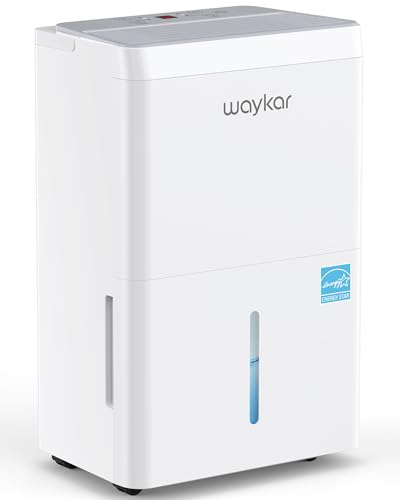
Waykar 6000 Sq.Ft Energy Star Dehumidifier, 120 Pint/Day
PURISYSTEMS Air Scrubber Industrial/Commercial Air Purifier
Waykar 5000 Sq. Ft. 80 Pints 2025 Energy Star Dehumidifier
Waykar 2000 Sq. Ft. 30 Pints 2025 Energy Star Dehumidifier
MOUNTO 268 Pints LGR Commercial Dehumidifier with Pump (Red)
Argendon LGR Commercial Dehumidifier with Pump, 180 Pints
Abestorm 180 PPD Commercial Dehumidifier with Pump for Crawl Spaces
Inside Each Recommended Option
Sometimes the right tool isn’t a machine. The Moismile bags are passive moisture grabbers built for the small, enclosed spots where a 50-pound electric unit would be absurd: under-sink cabinets, gym lockers, RV storage bays, and the back of a coat closet. They rely on calcium chloride beads, the same mineral salt you see in shipping containers, pulling water vapor from the air until they collect a small pool at the bottom.
For a beach house hallway that smells faintly of mildew, a 3-pack spread across three closets covers the kind of moisture an electric dehumidifier can’t reach anyway. Setup is essentially zero: tear the foil, hang the bag, wait two to four weeks. There’s no app, no fan noise, and no reason not to throw one in a tackle box.
A Few Highlights
- Truly grab-and-go: no power cord, no outlet, no drain to plan.
- Unscented formula won’t clash with stored clothing or linens.
- Hangs in places an electric unit physically cannot fit.
- 3-pack covers three rooms for the cost of a single mid-range filter elsewhere on this list.
Things To Consider
- Useless in open spaces, since airflow dilutes the calcium chloride’s reach almost immediately.
- Once saturated, each bag becomes a one-time use item you’ll need to replace, so the recurring cost can add up if you deploy many.
- The collected water sits in a pouch at the bottom; on smooth closet rods, owners commonly report tipping the bag to pour it out into a sink.
Who It Suits Best
Renters in older buildings with chronic closet dampness, or anyone needing quiet, off-the-grid moisture control in a small enclosed space.
Where Another Pick Suits Better
The Waykar 2000 Sq. Ft. 30 Pints is a stronger fit for open bedrooms or apartments where passive bags lose effectiveness fast.
For homeowners with a basement that runs damp from April through October, the Waykar 120-pint is the workhorse most people picture when they type “large capacity dehumidifier” into a search. It’s rated for spaces up to 6,000 square feet and pulls up to 120 pints per day under saturated conditions, which is more than enough to keep a finished basement, a large laundry room, or a two-story home with chronic humidity in a comfortable range. The 40 dB noise floor is genuinely low, closer to a soft library hum than a kitchen exhaust fan.
The tank-and-drain combination covers the two main ways people use these units day to day. Run the included hose to a floor drain and forget about emptying the tank; or skip the hose, let the auto-shutoff catch a full reservoir, and empty it as needed. Either way, the smart auto-comfort mode does the daily tuning so you’re not babysitting the humidistat.
Well-Handled Touches
- 120-pint extraction handles whole-basement moisture in a single unit, where smaller models like the Waykar 30-pint would struggle.
- Continuous drain option means you set it up once and walk away, no manual emptying on heavy humidity days.
- Energy Star efficiency keeps long-run electricity costs down compared to older compressor designs.
- Auto-defrost function lets the unit run in cooler basement temperatures without icing up the coils.
Worth Noting
- At full output, the compressor still adds heat to a small room; in a tightly sealed bedroom, you may find the air feels warmer.
- The 6,000 sq. ft. claim assumes open floor plans; closed-off basements with one return path will need a fan to push air toward the unit.
At A Glance
Made For
Homeowners with a finished basement, a large open living space, or a two-story home where humidity lingers despite running the AC.
Skip It When
The Abestorm 180 PPD makes more sense for restoration pros or anyone drying out a flooded space on a deadline.
The PURISYSTEMS isn’t a dehumidifier in the strict sense, but it earns its place on this list because moisture and airborne particles tend to travel together. A finished basement, a remodeling job, or a workshop rarely has just one air-quality problem. This scrubber layers a MERV-10 pre-filter for larger debris with a HEPA-grade MERV-17 final filter, which is the kind of fine-particle capture that matters when you’re working around concrete dust or drywall sanding. The integrated light and ionizer support jobs where air quality needs to be visibly clean, not just measurably so.
Pair it with a Waykar 120-pint in a drying-out basement, and you’ve covered both the water and the dust. Run it on its own in a woodshop, and it captures the fine sawdust that a regular fan just keeps blowing around. It’s the kind of tool contractors buy once and leave in the truck.
The Upside
- 5-stage filtration including a HEPA-grade MERV-17 final stage reaches 99.97% efficiency at 0.3 microns, a standard contractors look for.
- Captures concrete, gypsum, and fine sand dust that ordinary household purifiers let through.
- Built to handle the dust load of an active job site, not just a tidy living room.
Trade Offs
- Filter replacement is an ongoing cost: MERV-10 and MERV-17 stages both need swapping on a regular schedule during heavy use.
- It does not remove moisture from the air, so on its own it won’t solve a damp-basement humidity problem.
Best Suited To
Contractors, remodelers, and homeowners running a dust-heavy project who want clean air to breathe while the work is happening.
Not Your Match When
The Waykar 80-pint is the better pick if your real problem is humid air, not particulates, and you need moisture removal, not just filtration.
Think of the Waykar 80-pint as the middle child of the lineup. It’s smaller than the 120-pint basement buster but does the same job in homes that don’t quite need that much extraction. Rated for 5,000 square feet and pulling 80 pints a day under saturated conditions, it sits in the sweet spot for mid-size basements, multi-room setups, and homes where humidity shows up in summer but disappears in winter.
Compared to the 120-pint model, it costs less to run, fits in tighter mechanical rooms, and won’t over-dry a smaller home. The 30% to 80% adjustable humidity range covers the band most homes actually want, and the auto-comfort mode tunes cycling without you having to watch the display.
Real Benefits
- 80-pint extraction covers most homes that don’t need full 120-pint commercial output.
- Adjustable 30%-80% RH range keeps humidity in the comfort band without over-drying wood floors or furniture.
- Lower up-front cost than the 120-pint while sharing the same family of features.
Honest Caveats
- It can stall in very large basements during a wet spring, where stepping up to the 120-pint model keeps the unit from running constantly.
Quick Facts
Whose Shelf It Belongs On
Homeowners with a mid-size basement or a multi-room setup who want a balance between capacity and electricity use.
A Better Fit Elsewhere
The Waykar 6000 Sq.Ft 120-pint is the smarter pick for whole-home coverage in very damp climates or larger finished basements.
The 30-pint Waykar is the one to pick when “large capacity” is a relative term. For a one-bedroom apartment, a small office, or a finished bonus room over a garage, 30 pints per day is more than enough to keep the air from feeling heavy without drying out a small space. The 2,000-square-foot coverage is generous for the size, and the smaller compressor keeps noise down on quiet evenings.
It’s a step down from the 80-pint and 120-pint models, but that’s the point. In tight quarters, an oversized unit short-cycles, which is harder on the compressor and wastes electricity. Sized to the room, this one runs steadily, sips power, and disappears into the corner.
The Helpful Details
- Right-sized for small homes, where the bigger 80-pint and 120-pint units would short-cycle.
- Lower energy draw keeps the electric bill from climbing on continuous use.
- 15% to 80% RH range gives finer control in spaces where every percentage point matters.
Things To Weigh
- Cannot keep up in a basement over 2,000 square feet, especially during summer humidity peaks.
- The smaller tank fills faster when run continuously, so pairing it with a drain hose is a good idea for set-and-forget use.
Feature Snapshot
Right Fit For
Studio and one-bedroom dwellers, home office setups, and small finished rooms where a basement-rated unit would be overkill.
Reach For A Different Pick When
The Waykar 80-pint is the better call for a full basement or a multi-room setup that exceeds 2,000 square feet.
The MOUNTO steps into LGR territory, which stands for low-grain refrigerant, the tech used when air needs to be dried past what standard residential units can reach. At 268 pints per day, it’s built for water-damage restoration, large basements after flooding, and crawl spaces where every drywall panel and floor joist depends on aggressive drying. The integrated pump moves condensate upward and out, which is the difference between a unit that can sit in a basement corner and one that can sit in a pit with no floor drain nearby.
Compared to the residential Waykar models, this is a different class of machine. The wheels help you roll it to the next job, and the rugged housing takes the kind of dings a residential unit would not forgive. It’s overkill for a damp bedroom but exactly the right tool for a flooded carpet.
Benefits That Matter
- 268-pint daily extraction handles flooded basements, water-damage jobs, and saturated crawl spaces.
- Built-in pump lets the unit push water up and out when there’s no floor drain below.
- LGR technology reaches lower humidity levels than standard compressor dehumidifiers, useful for drying out framing.
Points To Note
- At residential-home scale, this is far more capacity than a single room needs, so it cycles off frequently and may not be the most efficient choice for everyday use.
- The commercial-grade housing adds weight and bulk; expect it to take up real floor space.
The Right Fit
Restoration contractors, property managers, and homeowners drying out a space after flooding or a leak.
Swap It Out When
The Waykar 6000 Sq.Ft 120-pint is the right call for everyday basement humidity without the commercial-grade bulk.
The Argendon sits between the heavy residential units and the biggest LGR machines. At 180 pints per day, it covers warehouses, workshops, and serious home basements that need more than a 120-pint but don’t need a 268-pint. The built-in pump removes the most annoying limitation of older commercial units: the requirement to sit at the lowest point in the room.
On a job where the dehumidifier has to be elevated, or where a floor drain is 10 feet away and uphill, that pump earns its keep. Coverage up to 2,300 square feet lines up with mid-size commercial spaces, and the LGR coil design reaches lower grains of moisture than a standard refrigerant setup.
Practical Pluses
- 180-pint capacity covers mid-size commercial and large residential spaces without the bulk of 268-pint units.
- Built-in pump moves condensate where a gravity drain cannot reach.
- LGR technology reaches lower humidity levels for drying wood, drywall, and concrete.
Worth Bearing In Mind
- Still sized for commercial spaces; the Waykar 120-pint is more appropriate for everyday home basements.
Built With In Mind
Workshop owners, serious DIYers, and homeowners with a chronic flooding issue who need a step above residential capacity.
Look Elsewhere When
The Abestorm 180 PPD is a comparable alternative with strong airflow (210 CFM) for crawl space drying where air movement matters as much as extraction.
Abestorm built the 180 PPD for the conditions that eat lesser machines: tight crawl spaces, water-damage jobs, and post-flood basements where the air is heavy enough to feel like rain. At 180 pints per day at saturation and 85 PPD at AHAM, the unit pairs serious water removal with a 210 CFM airflow rating, which is the metric that controls how quickly moist air gets to the coils. The built-in pump with overflow protection means you can leave it running without babysitting a bucket.
For a contractor, this is the daily driver. For a homeowner, it’s the unit to reach for after a sump pump fails. In normal residential use it’s overkill, but that’s not a flaw. It’s a tool designed to perform when the situation is past the ordinary.
Notable Gains
- 180-pint daily extraction handles saturated crawl spaces and post-flood basements.
- 210 CFM airflow moves moist air to the coils quickly, speeding up the drying process.
- Built-in pump with overflow protection enables unattended continuous drainage.
A Few Limitations
- Commercial noise levels in a quiet home basement can be intrusive; in an open crawl space, it’s fine.
- Filter maintenance schedules accelerate under heavy dust, a routine contractors track closely.
Feature Card
Who Should Grab It
Restoration pros and homeowners with persistent crawl space moisture or recurring basement water intrusion.
Consider Something Else When
The Argendon 180 Pints is a close alternative for users who prefer that brand’s pump layout and housing design.
Picking the Right Capacity and Setup for Your Space
Match the unit to the room before matching it to the brand. A common misstep is buying the biggest pint rating and assuming more is automatically better. A 120-pint unit in a 1,000-square-foot apartment short-cycles, which wears the compressor and over-dries the air. A 30-pint in a 4,000-square-foot basement runs constantly and never catches up. Square footage under the rated coverage and a relative humidity band of 30% to 50% in living areas is the comfort zone to aim for.
Drainage matters more than people expect. If a floor drain is within hose reach, run the continuous drain and skip the tank entirely. If not, the size of the built-in tank and the auto-shutoff behavior determine how often you walk over to empty it. For basements with no nearby drain, the commercial LGR units with built-in pumps earn their keep.
Airflow, Noise, and Placement
Airflow, measured in CFM, controls how fast humid air reaches the coils. In a wide-open basement, a higher CFM rating shortens the time it takes the room to hit your target humidity. In a tight crawl space, airflow matters even more, since stagnant air pockets can stay damp long after the rest of the area reads dry.
Noise is the trade-off. Residential units in the 40 dB range sit close to a quiet library, livable near bedrooms. Commercial LGR machines are louder, the kind of background hum that disappears in a workshop or a basement but becomes obvious in a finished living area. Place the unit on a hard surface away from walls if possible, since soft carpet can muffle the intake and overwork the compressor.
Filtration, Coils, and Long-Term Care
A washable filter is the minimum. Units that pair a pre-filter with a HEPA-grade stage, like the PURISYSTEMS scrubber, do more than the dehumidifier alone. For a pure dehumidifier, the coil design is what counts: LGR coils reach lower grain levels, which is the mass of water per pound of air, and that matters for drying wood framing or concrete after a flood.
Plan on monthly filter rinses in dusty conditions and an annual check on the coils for mold or debris, especially in coastal or basement setups. Skipping that is the fastest way to turn a long-life appliance into a short-term one.
Smart Choices That Hold Up
A dehumidifier is one of those purchases that quietly does its job for a decade, or loudly fails in a year. The difference is usually fit, not brand. Sizing, drainage, and the kind of room it’s running in matter more than chasing a top-of-the-line spec sheet.
Common Shopping Slip Ups
The single biggest mistake is matching capacity to a wish list rather than a measured room. A 6,000-square-foot rating means little if the actual basement is 800 square feet with low ceilings and tight returns. Measure the space and check the relative humidity with a cheap hygrometer before picking pints. The other frequent miss is ignoring the drain plan. A unit that has to be emptied twice a day in summer will get unplugged by August.
What The Higher Tier Buys
Stepping up from a residential 80-pint to an LGR commercial unit buys three things: lower achievable humidity, higher airflow, and a built-in pump. None of those matter in a guest bedroom. All of them matter the day a pipe bursts or a sump pump dies. The honest read is that for everyday comfort in a normal home, the mid-tier residential units cover the bases. For restoration work or chronic structural moisture, the commercial tier pays for itself in time saved and damage avoided.