


Humidity shapes how a home actually feels, far more than most people realize. Dry winter air cracks wood floors and irritates sinuses, while muggy summer rooms let mold creep into closets and crawlspaces. Picking the right indoor hygrometer turns guesswork into data so you can run a humidifier, dehumidifier, or HVAC system with real numbers behind every adjustment.
The seven models below cover a wide range of needs, from budget Bluetooth sensors to pro-grade air quality stations that read CO2 and PM2.5 alongside temperature and humidity. Use this shortlist to match a monitor to the room, the climate, and the level of insight you want.
How The Shortlist Stacks Up

GoveeLife 2.0 WiFi Hygrometer Thermometer with Gateway, Mini Sensor 3-Pack

GoveeLife Bluetooth Thermometer Hygrometer H5220, Large LCD Display 1-Pack

Temtop M10+ 6-in-1 CO2 Meter & Indoor Air Quality Monitor
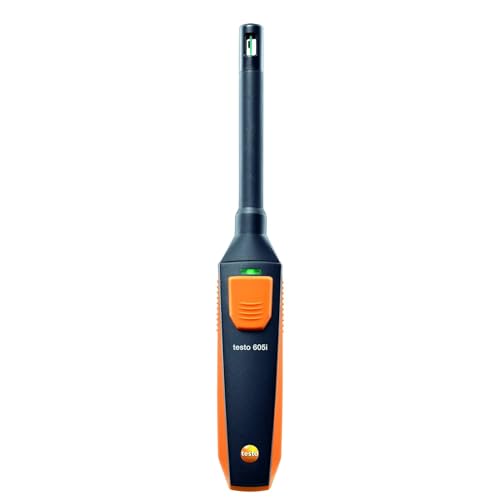
Testo 605i Thermohygrometer – Bluetooth In-Duct Humidity & Temperature Monitor
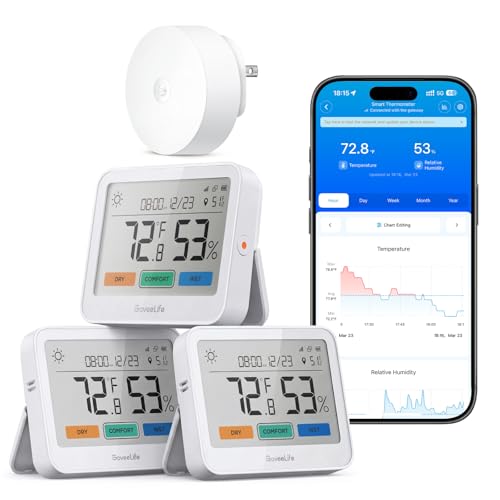
GoveeLife WiFi Thermometer Hygrometer 5-in-1, Large LCD 3-Pack with Gateway

Temtop Air Quality Monitor PM2.5 PM10 Particle Counter with Formaldehyde & Humidity

SwitchBot Thermometer Hygrometer, Bluetooth Indoor Humidity Meter with Large LCD (2 Pack)
Inside Each Recommended Option
This GoveeLife kit ships with three mini sensors and a small WiFi gateway, so a single 2.4 GHz network can pull data from every room in the house without juggling separate hubs. Each tiny disc pairs through the gateway, then sends temperature, humidity, and historical trends to the companion app for graphing and alerts. The two-year battery claim on the sensors is generous, though actual life depends on how often you poll data through the app.
Unlike the standalone GoveeLife H5220 reviewed next, this set focuses on coverage rather than display, so it suits a wine cellar, basement, and bedroom monitored from a single phone. Owners who want push alerts when humidity drifts out of range will get the most out of it. The trade-off is dependence on the gateway, since the sensors do not talk to WiFi on their own.
Useful Highlights
- One gateway handles up to 10 sensors, so a whole-home rollout is straightforward
- Swiss-made sensor claims roughly ±0.54°F and ±0.3°C accuracy, tight enough for HVAC tuning
- App-based alerts and 2-year data export let you spot slow seasonal drift in a wine cellar
- Magnetic or adhesive mounting makes placement on ductwork or shelving easy
Things To Consider
- Requires a 2.4 GHz WiFi network; 5 GHz routers will not connect without guest-mode setup
- Sensors do not display readings locally, so you rely on the app for everything
- Battery life depends on polling frequency, and owners commonly report faster drain with aggressive alert settings
Key Specs
Whose Shelf It Belongs On
Multi-room households and small business owners who want one app view across a wine cellar, basement, and nursery without juggling separate Bluetooth sensors.
Where Another Pick Suits Better
The Testo 605i is a stronger fit for HVAC technicians who need a bendable in-duct probe rather than a stationary room sensor.
The H5220 is the most approachable pick on this list: a compact Bluetooth unit with a large LCD that shows temperature, humidity, a comfort indicator, and even the time without opening the app. It skips WiFi entirely, which is a relief for anyone who does not want yet another device on the home network. The Bluetooth range is generous on paper, reaching up to 196 feet in open air, though walls will cut that down considerably in most homes.
Compared to the multi-sensor GoveeLife kit at pick 1, this one trades multi-room coverage for a clear at-a-glance readout on a desk, nightstand, or workbench. It works as a stand-alone thermometer, so the app is purely optional for those who prefer a low-fuss setup. The honest read is that this is the right pick when you need a single room, not a whole house.
Everyday Advantages
- Readable LCD shows time, temperature, humidity, and a comfort icon in one glance
- Bluetooth-only design avoids WiFi password headaches and keeps setup fast
- Optional gateway H5044 can extend range up to 1640 feet for larger layouts
Honest Caveats
- Single sensor only, so you would need multiple units to cover several rooms
- Bluetooth range drops sharply through masonry or foil-backed insulation
- No built-in display of trends, so historical patterns require the app
Best Suited To
Bedrooms, nurseries, and home offices where a clear at-a-glance reading matters more than remote multi-room data.
Consider Something Else When
The Temtop M10+ is a smarter fit when you also want CO2 and PM2.5 readings alongside humidity in a single tabletop unit.
Temtop’s M10+ stretches the definition of a hygrometer by folding CO2, PM2.5, TVOCs, temperature, and humidity into a single countertop unit. CO2 readings matter most in bedrooms and home offices, since elevated levels track closely with drowsiness and reduced focus during long workdays. The Temtop app pushes real-time data, history graphs, and exportable logs, so it doubles as a trend tracker for sensitive households.
Where the GoveeLife H5220 covers only one or two variables, this device replaces a small stack of single-purpose meters. That breadth is its real selling point, and the unit feels at home on a desk or workshop bench. The trade-off is a slightly larger footprint and the need for periodic recalibration as the gas sensors age.
Notable Gains
- Six readings in one unit, including CO2, which most hygrometers skip entirely
- App-based history logging is useful for documenting air quality in a child’s room
- Compact enough for a desk, with a clear front display for quick checks
Worth Noting
- Gas sensors typically need recalibration every 12 to 24 months depending on use
- Larger than a simple hygrometer, so it takes up meaningful shelf space
Key Specs
Who It Suits Best
Homeowners and remote workers who want a single tabletop device for bedroom CO2, office air, and living-room humidity without buying multiple meters.
Look Elsewhere When
The Temtop 7-in-1 particle counter is a better match when formaldehyde and PM10 readings are part of your monitoring goals.
Testo’s 605i is a different kind of tool, built for HVAC technicians, energy auditors, and serious DIYers rather than casual room monitoring. The compact probe head bends 90 degrees, so it slides into supply boots, return ducts, and crawlspace registers that would be awkward for a flat tabletop sensor. Live data flows directly to a phone or tablet through Bluetooth, with the Testo Smart Probes app handling calculations and reporting.
Compared to the multi-room GoveeLife kit earlier in this list, the 605i trades whole-home coverage for accuracy in one specific spot. It is the right tool when you need to confirm a duct is delivering 50% relative humidity at the register, not just a living room. The cost is the workflow, since readings only show up on a paired device.
Strong Points
- 90-degree bendable probe reaches inside ducts and tight registers cleanly
- Bluetooth data streams live to iOS or Android apps for on-the-spot reporting
- App handles dew point, wet bulb, and other HVAC-specific calculations automatically
Practical Considerations
- Single-point tool, not a leave-in-place monitor for ambient room readings
- Requires a phone or tablet on the job, which adds a step versus a tabletop display
Key Specs
Made For
HVAC technicians, home energy auditors, and advanced DIYers who need duct-level measurements rather than ambient room readings.
Swap It Out When
The GoveeLife 2.0 WiFi kit is a better everyday fit when you want continuous, leave-in-place room monitoring across several spaces.
GoveeLife’s 5-in-1 set adds local weather forecasting and a color-coded comfort indicator on each display, layering convenience on top of the multi-sensor WiFi approach used in the earlier kit. Three large-LCD units ship with a single gateway, so the bedroom, living room, and kitchen can each show a face-friendly readout while still feeding data to the app. The claimed 1640-foot open-air range through the gateway is impressive, even if real-world walls and floors bring that down.
Where the 2.0 mini sensors hide behind the app, these displays make a room’s status obvious from across the room. That makes the set a good fit for households with kids or older family members who want a glanceable reading. The trade-off is that three displays and a gateway take up more space than three disc-shaped sensors.
Good Reasons To Consider
- Three LCDs give a clear at-a-glance reading in multiple rooms
- Built-in comfort indicator helps family members see good versus bad humidity without an app
- Up to 1640-foot range through the gateway handles most large homes
Points To Note
- Larger footprint than the mini sensor kit, so placement needs more planning
- Weather forecast requires a separate gateway H5044 if you do not already own one
Best Suited To
Smart home households and growing families who want visible readings in three rooms plus remote monitoring through a single app.
Reach For A Different Pick When
The SwitchBot two-pack is a leaner option when only one or two rooms need a visible display and you do not need WiFi at all.
This Temtop monitor widens the air-quality net to seven readings, adding PM10, formaldehyde (HCHO), and an AQI summary on top of what the M10+ already covers. A laser particle counter and an electrochemical formaldehyde sensor sit at the heart of it, which is a meaningful step up from cheaper semiconductor-based detectors. The unit is designed for trend tracking rather than spot readings, so you can correlate seasonal changes, renovation dust, or wildfire smoke with humidity shifts.
Compared to the GoveeLife kits earlier, this device is overkill for a casual shopper and right on target for a workshop, lab, or post-renovation home. Data export is the key feature, since it lets you document indoor air quality for a sensitive family member or a warranty claim. The trade-off is price and the cost of running a laser sensor long term.
What Earns Its Place
- Laser particle sensor plus dedicated HCHO sensor handle particulates and gas accurately
- Seven readings, including PM10 and AQI, give a fuller air-quality picture
- Data export helps document trends after renovations or wildfire smoke events
Trade Offs
- Laser sensor is designed for a 3-year lifespan, so this is a longer-term investment
- More expensive than a basic hygrometer, with a steeper learning curve for casual users
Key Specs
Who Should Grab It
Workshops, home offices, and post-renovation households that want deeper air-quality data than a basic hygrometer can offer.
Not Your Match When
The GoveeLife 2.0 WiFi kit makes more sense when humidity monitoring across multiple rooms is the only goal.
SwitchBot’s two-pack leans into a Swiss-made sensor rated for ±0.4°F temperature accuracy and ±2% RH humidity accuracy, with readings refreshed ten times per second. The result is a tight, responsive display that does not feel laggy when humidity swings during a shower or while drying clothes. The two-unit bundle is a practical way to cover, say, a plant room and a nursery without paying for a full multi-room gateway.
Unlike the WiFi-equipped GoveeLife sets earlier, this kit stays on Bluetooth, so it works best within roughly 30 to 50 feet of a paired phone. For SwitchBot ecosystem users, the sensors can trigger automations through the SwitchBot hub. The honest read is that this is a friendly, accurate, low-fuss pair rather than a professional air-quality station.
A Few Strong Suits
- Swiss sensor and ten readings per second keep the display responsive during rapid swings
- Two-pack covers a plant room and a child’s room at a sensible cost
- Notification alerts and data export support casual trend tracking
Points To Keep In Mind
- Bluetooth range limits how far sensors can sit from a paired phone or hub
- No CO2 or particulate sensing, so it does not replace an air-quality monitor
The Right Fit
Plant caretakers, greenhouse hobbyists, and households that want a simple, accurate humidity reading in two specific rooms without a WiFi setup.
A Better Fit Elsewhere
The Temtop M10+ suits you more when you also want CO2 and particulate readings in a single tabletop unit.
What Matters Most Before Choosing Indoor Hygrometers
Accuracy and Sensor Quality
The best indoor hygrometer is only useful if you can trust the reading. Look for units that list an accuracy range, typically expressed as ±°F and ±% RH. A Swiss-made sensor with ±0.3°C temperature and ±2% RH humidity accuracy is a strong starting point for climate-sensitive spaces like wine cellars, instrument cases, or nurseries. Cheaper sensors can drift noticeably within a year, so checking for published specs matters more than chasing the lowest price.
Connectivity and Range
Decide how you want to read your data. Bluetooth-only models like the SwitchBot two-pack keep setup simple and avoid WiFi headaches, but the range is shorter and you usually need a phone nearby. WiFi-connected kits with a gateway, such as the GoveeLife 2.0 set, can cover an entire home and push alerts when humidity leaves a safe range, but they require a 2.4 GHz network and a small hub plugged into your router. For pros, a probe-based tool like the Testo 605i trades continuous monitoring for duct-level accuracy.
Power and Maintenance
Battery-powered sensors need eventual cell swaps, and the manufacturer-claimed life can drop quickly with frequent polling. USB-powered air quality monitors like the Temtop units avoid battery swaps but tie you to an outlet, and gas sensors may need recalibration every year or two. Think about where each sensor will live and how often you can comfortably reach it for service.
Extra Sensors and Air Quality
A pure hygrometer covers temperature and humidity, which is enough for most homes. Air quality monitors add CO2, PM2.5, PM10, VOCs, and formaldehyde readings that matter in tightly sealed houses, workshops, or homes with allergy sufferers. If you only need humidity, a focused two- or three-pack is the smarter spend.
Smart Shopping Habits for Indoor Hygrometers
Wrong Turns To Avoid
Placing a sensor right next to a window, exterior wall, or heating vent is a common mistake, since direct sun or drafts skew the reading. Another slip is trusting a $5 unbranded dial hygrometer for climate control, when its accuracy often drifts by 10% RH or more. Finally, do not skip reading range claims. A sensor rated for 5% to 95% RH may behave poorly at the extremes that actually matter in a basement or attic.
When Paying More Pays Off
Spending more usually buys three things: a published accuracy spec, a Swiss or similarly high-grade sensor, and connectivity that removes the need to check readings by hand. The Temtop monitors earn their price by replacing a stack of single-purpose meters, while the Testo 605i earns it through duct-level access. For most households, a mid-range WiFi or Bluetooth kit is the right call, and the high-end gear makes sense only when the data feeds a real decision.
Frequently Asked Questions
How accurate do indoor hygrometers need to be?
For most homes, ±2% RH and ±0.5°F are accurate enough to drive a humidifier or dehumidifier. Wine cellars, instrument rooms, and similar climate-sensitive spaces benefit from tighter ±0.3°C and ±2% RH ratings.
Where should you place an indoor hygrometer?
Aim for a spot away from direct sunlight, exterior walls, and HVAC vents, roughly at breathing height. Living areas, bedrooms, and basements each warrant their own sensor since humidity varies room to room.
Do Bluetooth hygrometers work without a phone nearby?
Most Bluetooth sensors store recent readings and sync once the phone returns, but live display and alerts still need a paired device. WiFi gateway kits keep monitoring even when your phone is off.
How often should you replace batteries in a wireless hygrometer?
Expect roughly 12 to 24 months on coin cells for typical polling, though aggressive alert settings can shorten that. The GoveeLife 2.0 kit claims up to two years per sensor under standard use.
Can a hygrometer help with allergies or mold?
Yes, by keeping humidity in the 40% to 55% range you reduce dust mite activity and limit the conditions mold needs to grow. Pairing the reading with a humidifier or dehumidifier turns the data into action.
Closing Remarks
The right indoor hygrometer is the one that fits the room, the climate, and your willingness to check an app. A two-pack Bluetooth sensor is plenty for a plant corner, while a WiFi gateway kit pays off once you are tracking three or more rooms. Match the device to the decision you actually want to make, and the rest of the data tends to take care of itself.