


Dry winter air pulls moisture from your skin, cracks hardwood floors, and makes static cling a daily nuisance. For households running a forced-air furnace, the right humidifier can quietly turn around sleep quality and indoor comfort, especially when rooms sit far from a portable unit. This roundup covers six whole-house and large-room options that tackle dryness head-on, from furnace-mounted evaporative systems to a top-fill cool-mist tank and even a cast-iron stove steamer. Each pick is matched to a clear use case, so you can zero in on what fits your home, your heating setup, and your tolerance for refills.
The Leading Options At A Glance

LRAZU 15L Cool Mist Humidifier 800 sq.ft Coverage

INNO STAGE Wood Stove Steamer Cast Iron 2.5 Quart

AprilAire 600M Whole-House Humidifier 5,000 Sq. Ft.

AprilAire 500 Whole-House Humidifier 3,600 Sq. Ft.
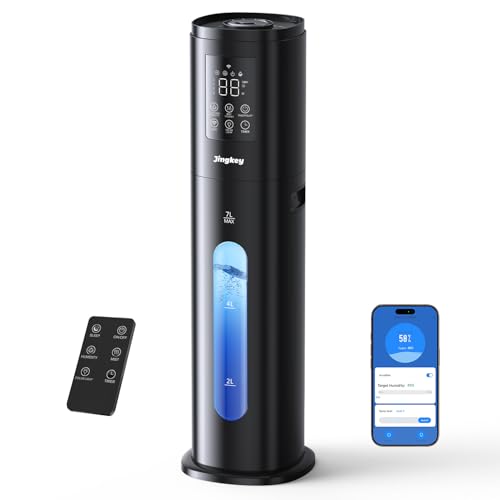
Jingkey 7L Smart Humidifier App & Remote

AprilAire 700 Whole-House Humidifier 5,300 Sq. Ft.
A Deeper Look At The Lineup
The LRAZU 15L cool-mist humidifier is built for spaces where a small bedroom unit simply cannot keep up. Its 15-liter (around 3.96 gallon) tank pushes a stated 350 mL/h of mist, and the maker rates it for rooms up to roughly 800 square feet. In a real home that means open-plan living areas, finished basements, or a long stretch of connected bedrooms all benefit from a single fill.
You get five mist levels plus a humidity range of 40% to 90%, so you can dial back output in a smaller room and crank it up when the furnace has been hammering dry air. Compared with the furnace-mounted picks later in this list, LRAZU requires no installation, no bypass duct, and no plumber. You unbox it, fill the tank, plug it in, and let the ultrasonic membrane (a vibrating plate that turns water into a fine cool fog) do the work.
Useful Touches
- 15L tank supports long runtimes between refills, ideal for households that hate daily top-ups.
- 350 mL/h output keeps large living spaces noticeably less dry overnight.
- Five mist settings and a 40% to 90% humidity target cover everything from bedrooms to plant rooms.
- Casters or a slim footprint make it easier to move between a home office and a living room on different days.
Points To Keep In Mind
- Ultrasonic tanks commonly need weekly descaling in hard-water areas, so plan for a vinegar rinse cycle.
- At nearly 16 kg when full, refills are easier with a pitcher than hauling the whole unit to a sink.
Key Product Details
Right Fit For
Renters, plant parents, and households without a forced-air furnace who want one tank to cover a large room without permanent installation.
Look Elsewhere When
You actually want the ducts themselves to carry moisture to every room, in which case the AprilAire 500 is a smarter match for a mid-size home.
The INNO STAGE steamer does one job and does it without a single watt of electricity. You set the cast-iron pot on top of a wood stove, fill it with water, and the heat does the rest, evaporating moisture into the room while doubling as a stove-side ornament. The 2.5 quart (around 2.8 L) capacity holds enough water for a long evening burn.
The matte black finish and lattice-style lid keep the look understated next to a hearth, and the enamel coating helps the cast iron resist rust during long heating seasons. Unlike the ultrasonic LRAZU above, this is a passive device, so output depends entirely on stove temperature, and you will see more steam on a hot burn than a low one.
The Value In It
- No power, no filters, and no controls to learn, just water and a hot stove.
- Cast iron with an enamel finish holds heat well and resists rust through repeat seasons.
- Lattice top gives the steam a wider exit path so the pot does not rumble or spit.
- You can add a few drops of stove-safe scent to the water for a subtle room fragrance.
Trade Offs
- Effectiveness drops sharply when the stove is idling, so it is not a true whole-house solution.
- Around 9.2 lb empty, it needs a steady, level spot on the stove top where children and pets cannot reach it.
Best Suited To
Cabin owners and anyone heating with a wood stove who wants a low-effort humidity boost right where they already gather.
Swap It Out When
You need humidity across an entire home rather than just the room with the stove, in which case the AprilAire 600M is a much better match.
The AprilAire 600M is the muscle pick of the roundup. It is a furnace-mounted evaporative unit (a system that uses a fan and a wick filter to blow dry air through moistened material) rated for tightly built homes up to 5,000 square feet, with a stated 17 gallons per day output. The “M” stands for manual, which means a single sensor and a simple dial rather than the automatic control on the 500 and 700.
You mount it on the supply or return plenum (the metal duct trunk connected to your furnace), run a water line to it, and let the HVAC fan carry moisture into every register. Compared with the LRAZU tank above, this is a permanent install, but it covers the whole house without you hauling a tank around.
The Case For It
- 17 GPD output supports large, tight homes where smaller units run constantly without catching up.
- Manual control keeps the part count and price lower for homeowners comfortable tuning a humidistat themselves.
- Plumbing into a water line removes the daily refill chore that portable tanks demand.
- AprilAire has been building whole-home evaporative units since the 1950s, so replacement parts and filters are easy to find.
Honest Caveats
- Installation calls for basic duct and water-line work, so many homeowners hire an HVAC tech.
- The water panel (the replaceable wick that absorbs and evaporates water) needs a swap roughly once per heating season in typical use.
Feature Snapshot
Who Should Grab It
Owners of large, well-sealed homes who want a high-output manual unit and are comfortable with a one-time professional install.
Reach For A Different Pick When
You would rather not touch a humidistat dial, in which case the automatic AprilAire 500 makes more sense for a mid-size house.
The AprilAire 500 is the model most mid-size homes actually need. It carries the same basic evaporative design as the 600M but drops the coverage ceiling to 3,600 square feet and adds an automatic humidistat (a control that turns the unit on and off based on a target humidity reading). You set it once and the unit keeps the rest of the house on track.
Inside, water feeds a distribution tray at the top of the unit, saturates the water panel, and the HVAC blower pulls dry air through it on each heat cycle. That is a quieter, less visible operation than the LRAZU cool-mist fogger, and you hear nothing from the living room when the furnace fires up.
The Good Stuff
- Automatic control reads the air and adjusts output, so you do not fiddle with the dial each week.
- 3,600 sq ft coverage suits most suburban family homes without overworking the unit.
- Plumbed water line removes the need to top off a tank, a real plus on busy weeks.
- Replacement water panels are widely available and slot in without tools.
Some Limits To Know
- Annual water panel swaps are mandatory; skipping them tanks efficiency and can let mineral dust into ducts.
- Coverage assumes a tightly built home, so older, drafty houses may need the 600M or 700 instead.
Quick Facts
Made For
Suburban households of three to five people who want a set-and-forget whole-house unit that matches a typical 3,000 sq ft envelope.
A Better Fit Elsewhere
Your home runs larger than 3,600 sq ft or sits in a very dry climate, in which case stepping up to the AprilAire 700 keeps output from being the bottleneck.
The Jingkey 7L is a smart, room-first humidifier aimed at people who want fine control from their phone rather than ductwork. Its 7 liter (1.85 gallon) tank is generous for a bedroom, and four mist levels let you tune output across nap times, sleep, and reading hours. You also get a 24-hour timer and both an app and a handheld remote.
A built-in humidistat reads the room in real time and pauses mist when the target humidity is hit, then restarts as the air dries. The trade-off versus the furnace picks is reach. A single tank can only push moisture so far, so this is really a one- or two-room solution, not whole-house.
Where It Helps
- App and remote control mean you can adjust mist from bed or from another floor.
- Built-in humidistat avoids the over-humidification that turns windows foggy in small rooms.
- 7L tank is large enough to cover a full night in a typical bedroom without refilling.
- Four mist levels plus a 24-hour timer support light sleepers and shift workers.
Practical Considerations
- Not a whole-home solution, so it works best in one or two rooms rather than the full floor plan.
- Like all ultrasonic units, it benefits from filtered or distilled water in hard-water regions to slow white dust on nearby surfaces.
Whose Shelf It Belongs On
Smart-home fans, nursery households, and anyone who wants phone-based humidity control in a single room without touching a furnace duct.
Where Another Pick Suits Better
You need moisture carried into multiple rooms at once, where the LRAZU 15L or one of the AprilAire furnace models is the more honest answer.
The AprilAire 700 is the flagship of the lineup. It uses a built-in fan to pull air through the water panel independent of the furnace blower, which means it can add moisture even when the heat is not running. The 5,300 square foot coverage ceiling edges out the 600M, and the automatic control makes it the closest thing to a set-and-forget whole-house unit in this roundup.
The fan is the headline difference versus the 500. You hear a soft whir when it cycles, but you also get more consistent humidity through shoulder seasons when the furnace barely fires. For very dry, very large homes that have struggled with smaller AprilAire models, the 700 is the natural upgrade path.
Reasons It Performs
- Built-in fan moves moisture into the ducts even when the furnace is off, useful in fall and spring.
- 5,300 sq ft coverage handles the largest homes in the roundup, including custom builds.
- Automatic humidistat keeps the whole house inside a target range without manual tweaks.
- Plumbed water feed and a sealed water panel design lower the day-to-day maintenance load.
Worth Bearing In Mind
- Higher upfront cost than the 500 or 600M, so the upgrade only pays off in larger or drier homes.
- The internal fan adds a small noise footprint, audible up close but usually masked by living-room sound.
Built With In Mind
Owners of large custom homes, multi-zone HVAC systems, and properties in very dry climates who want the strongest whole-house coverage in the AprilAire line.
Consider Something Else When
Your home sits closer to 2,500 sq ft, where the AprilAire 500 will give you the same automatic convenience at a friendlier entry cost.
What To Weigh Before Picking A Whole-House Humidifier
Match The System To Your Heating Setup
Furnace-mounted evaporative units like the AprilAire 500, 600M, and 700 need a forced-air system, a nearby water line, and a spot on the supply or return plenum. Portable cool-mist tanks and stove steamers work without any of that, but they only push moisture into the room they sit in. Picking a whole-house humidifier starts with honestly answering how your home is heated and how much ductwork you are willing to tap into.
Output And Coverage Have To Match Your Square Footage
Manufacturer coverage numbers assume a tight envelope. For an older home with drafts, you usually want one tier higher than the rated square footage would suggest. If you sit between two models and your winters are long and dry, lean toward the higher-output pick.
Filter And Panel Costs Add Up
Evaporative units run on replaceable water panels, and those wicks should be swapped roughly once per heating season to keep output and air quality from slipping. Ultrasonic tanks may need weekly descaling in hard-water areas, which is more frequent but cheaper. A whole-house humidifier is not just a purchase, it is a small recurring maintenance line item.
Control Style Changes Daily Habits
Manual humidistats on the 600M ask you to check the dial and adjust with the weather. Automatic units like the 500 and 700 read the air and react on their own. Smart room units like the Jingkey put the controls in an app, which is great for one room but does not solve a whole house. Pick the control style that matches how often you actually want to think about humidity.
Key Considerations Across These Picks
Where Shoppers Go Wrong
The most common slip is matching a tank humidifier to a true whole-house need. A 15-liter LRAZU looks generous until you try to push humidity into four bedrooms and a living room with closed doors, and the runtime math falls apart fast. The opposite mistake is buying a furnace humidifier for a home without forced-air ducts, which leaves you with a beautiful install that cannot be mounted anywhere sensible.
Where The Extra Money Goes
Higher-tier picks like the AprilAire 700 earn their premium through a built-in fan, larger output, and automatic control. In dry climates or large homes, that extra capacity turns a marginal improvement into a noticeable comfort change. In a small, well-sealed home with mild winters, the same money spent on a 500 and good weatherstripping tends to do more for daily comfort than the upgrade itself.
Frequently Asked Questions
How many gallons per day does a whole-house humidifier actually need?
Most mid-size homes settle around 10 to 12 gallons per day once the system is dialed in. Larger homes in dry climates can push past 15, which is where high-output picks like the AprilAire 600M and 700 earn their place. Sizing output to your climate matters more than chasing the largest number on a spec sheet.
Can a portable humidifier cover a whole house?
A large tank like the LRAZU 15L can handle a single open-plan area up to about 800 square feet, but it will not reach closed-off bedrooms down the hall. Whole-house coverage really needs a furnace-mounted unit that ties into the ductwork, or a humidifier in every major zone.
How often do water panels need changing?
Plan on one replacement per heating season in typical use, with a swap sooner if you notice mineral buildup or a drop in output. Skipping the swap is a common shortcut that quietly tanks performance and can let dust into the ducts.
Is a wood stove steamer enough for a whole house?
A cast-iron steamer like the INNO STAGE adds real moisture to the room with the stove, but it tapers off fast in distant rooms. Treat it as a supplement to a primary system, not a replacement, unless your home is genuinely small and stove-centric.
Do ultrasonic humidifiers need special water?
Ultrasonic units vibrate water into a fine mist, so any minerals in the water end up as fine white dust on nearby furniture. Filtered or distilled water cuts the dust sharply, especially in hard-water regions, and extends the life of the membrane.
The Takeaway
Whole-house humidity is mostly about matching the system to the home. Furnace-mounted evaporative units carry moisture into every room through the ducts, while large cool-mist tanks and smart room models handle one space at a time with no installation. Pick the form factor that fits your heating system and your tolerance for refills, and the right choice usually becomes obvious.