


Large rooms and open floor plans punish small humidifiers. A unit that can handle a bedroom chokes on a great room with vaulted ceilings, leaving you with a steam plume in one corner and bone-dry air everywhere else. Evaporative models solve that differently from ultrasonic or warm-mist units: a wick pulls water into an airstream, and the natural evaporation process self-regulates output as room humidity rises, which means less babysitting and fewer puddles on your wood floor.
You will find six solid options below, ranging from a true whole-house furnace-mount unit to compact smart tanks that work nicely for apartments and bedrooms. Each one has a real reason to exist, and the trade-offs are spelled out honestly so the right match for your space is easy to spot.
The Picks In Brief

AprilAire 600M Whole-House Furnace Humidifier
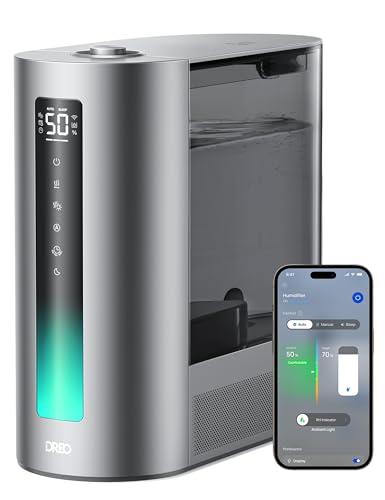
DREO 6L Smart Humidifier Warm & Cool Mist

DREO 11L Smart Humidifier 747S

DREO 6L Smart Humidifier Large Room

Carepod One Stainless Steel Humidifier

Carepod Cube Plus X50V Stainless Steel Humidifier
Inside Each Recommended Option
Evaporative humidifiers fall into two camps: portable tanks you refill and whole-house units that wire into your forced-air furnace. The AprilAire 600M sits firmly in the second camp, and the upside is serious output, around 17 gallons per day, delivered through the existing ductwork of homes up to roughly 5,000 square feet. The manual control keeps operation simple, with a single on-board sensor reading indoor relative humidity and a manual damper to dial in output by season.
Installation usually calls for a pro or a confident DIYer with access to the supply plenum, a 110V outlet, and a nearby cold-water saddle valve. Once mounted, the wick-based evaporation runs quietly in the background and self-regulates, so you are not babysitting a tank every eight hours the way you would with any of the DREO portables below.
Notable Upsides
- Delivers up to 17 GPD, enough to humidify a tightly built 5,000 sq ft home in dry winter conditions.
- Runs through your furnace blower, so humidity reaches every room with consistent ducts.
- Manual control with a built-in sensor keeps the interface simple and the cost lower than digital models.
- Evaporative wick technology means no visible mist, no white dust, and minimal risk of over-humidifying.
Things To Consider
- Requires a forced-air furnace and a drain line or condensate pump, which not every home has in a convenient spot.
- Annual wick replacement is part of ownership, and skipping it tanks performance.
- Not a fit for radiator, boiler, or ductless-mini-split households.
Key Specs
Made For
Owners of large, tightly built single-family homes with a forced-air furnace who want true whole-house humidity without hauling a tank around.
Consider Something Else When
You live in a small apartment or a ductless home, in which case the Carepod One stainless steel humidifier is a far easier fit.
The DREO 6L is the one to look at if you want warm-mist comfort on demand without losing the cool-mist option in summer. Its MistWave tech pushes a roughly 40-inch mist column, which helps the vapor reach across a larger room instead of pooling at the base. The 6-liter tank translates into multi-day runtime in a typical bedroom, and warm mist is ready in about five minutes, handy on a cold morning when you walk into a dry room.
Compared to the AprilAire 600M, this is a portable unit with no installation, no plumbing, and no ductwork. That portability is the whole point: you can move it from the bedroom to the living room and back, as long as you are within reach of an outlet and a sink for refills.
Key Advantages
- Heated mist at about 133°F arrives quickly, useful in cold bedrooms and during cold-and-flu season.
- 40-inch mist height helps humidity reach across larger open rooms, not just the immediate area around the unit.
- Three operating modes give real control over output and noise, depending on time of day.
- 6L capacity means fewer midnight refills than a typical 4L tank.
Worth Noting
- Heated mist uses more power and warms the room slightly, a small thing but worth knowing in summer.
- Any warm-mist humidifier needs regular descaling, depending on your water hardness.
Right Fit For
Bedroom dwellers who flip between warm and cool mist across the year and want meaningful output in a single-room space.
Skip It When
You want to humidify a large open-plan living area nonstop, in which case the DREO 11L Smart Humidifier 747S covers more ground per fill.
Bigger tank, longer runtime, taller mist plume: the DREO 747S pushes the brand’s portable format into genuinely large-room territory. The 11-liter reservoir is rated for up to 100 hours on a low setting, which means you can leave it running for a long weekend without refilling. The roughly 6-foot mist column is the headline spec here, helping moisture disperse evenly across spaces up to 700 square feet.
At around 21 dB on the lowest setting, it sits firmly in “sleep-friendly” territory, a useful contrast to the louder ultrasonic competitors in this category. Where the AprilAire 600M serves the whole house through ductwork, this one is for a single large zone, think a primary bedroom suite or an open living area.
Practical Advantages
- 100-hour runtime reduces refills to roughly once a week in typical use.
- 6-foot mist column throws moisture higher and farther than standard portable units.
- 21 dB low-mode operation keeps it background-quiet for sleep.
- 700 sq ft coverage comfortably handles living rooms, primary suites, and home offices.
Trade Offs
- An 11L tank is heavy to carry when full, so plan refills near a sink.
- Larger footprint than the 6L DREO models; not ideal for cramped nightstands.
Feature Snapshot
Best Suited To
Light sleepers and busy households who want a single unit to cover a large room for days without touching it.
Look Elsewhere When
Cleanability is your top concern and you prefer a stainless steel tank, in which case the Carepod Cube Plus X50V is the smarter call.
This 6L DREO sits in the middle of the lineup between the warm-mist model above and the giant 11L tank. Where it pulls ahead is software: a next-gen humidity sensor, a connected app, voice control support, and a clear humidity display on the unit itself. The auto mode reads the room and adjusts output to hold your target, so you set it once and let the unit do the thinking.
At around 28 dB on low and roughly 60 hours of runtime, it is a smaller, quieter sibling of the 747S. It makes more sense in a single bedroom or office than in a 700 sq ft great room, but for smart-home households, the control set is the selling point.
Standout Benefits
- Auto mode uses the onboard sensor to maintain your target humidity without manual tweaks.
- App and voice control let you adjust output from bed or from the next room.
- Customizable display lighting so the unit does not light up the whole bedroom at night.
- 28 dB low-mode operation keeps fan noise out of quiet environments.
Honest Caveats
- 6L tank means more frequent refills than the 11L DREO 747S in the same space.
- Smart features are only as useful as your stable Wi-Fi, a small thing but real in older homes.
Who Should Grab It
Connected-home users who want humidity tied into routines, automations, and voice assistants without mounting a furnace unit.
Another Choice May Suit
You want set-and-forget runtime for a long trip, in which case the DREO 11L Smart Humidifier 747S stretches further on a single fill.
Most humidifiers are made of plastic, and most of them are a pain to keep clean. The Carepod One is the antidote: a stainless steel reservoir that disassembles into just three washable parts, with a boil-to-clean feature that sterilizes the inside without scrubbing. For households with allergies, asthma, or a baby in the room, that simplicity is the whole reason to look at it.
The 4L tank is smaller than the DREO portables, rated for around 30 hours on a low setting, so it trades runtime for cleanability. It is also filter-free, which removes one of the recurring costs that catches people off guard with other brands.
Noteworthy Benefits
- Three-part disassembly makes weekly cleaning actually doable in real life.
- Stainless steel reservoir resists biofilm and odor better than typical plastic tanks.
- Filter-free operation removes the cost and hassle of replacement cartridges.
- Boil-to-clean cycle sanitizes without chemicals, useful in nurseries and allergy households.
Points To Keep In Mind
- 4L capacity means more frequent refills than the 6L or 11L DREO models.
- Stainless steel adds weight, so it is not the lightest unit to carry to the sink.
Whose Shelf It Belongs On
Parents, allergy sufferers, and anyone who has given up on cleaning a plastic tank with a bottle brush.
Reach For A Different Pick When
You want longer runtime and warm-mist flexibility, in which case the DREO 6L Smart Humidifier Warm & Cool Mist fits better.
The Cube Plus X50V is the Carepod One’s older sibling, with the same stainless steel, three-part design language and a more advanced feature set on top. You get warm or cool mist, three output levels, auto-humidity mode, auto shut-off, and a one-touch built-in heat sanitization cycle. The 4.2L tank stretches runtime to about 32 hours, slightly more than the smaller Carepod.
For wellness-focused households, the upgrade worth thinking about is the heat sanitization: a one-button cycle that helps keep the water path clean between manual washes. The trade-off is price and a slightly larger footprint, and you give up the boil-to-clean feature of the One in exchange for a different sanitization approach.
Where It Delivers
- Warm and cool mist in one unit, useful across changing seasons.
- Auto-humidity mode holds your target without manual adjustments.
- One-touch heat sanitization keeps the water path cleaner between washes.
- Filter-free design avoids recurring cartridge costs.
A Few Limitations
- Priced higher than the simpler Carepod One for features you may not need.
- Smaller reservoir than the 11L DREO, so refill frequency is higher in large rooms.
Feature Rundown
Perfect Match For
Wellness-oriented households that want warm-mist comfort, clean water handling, and minimal filter maintenance in one unit.
Swap It Out When
You primarily need a large-room tank and quieter output, in which case the DREO 11L Smart Humidifier 747S covers more square footage per fill.
Choosing Evaporative Humidifiers For Large Room That Actually Fit
Tank Size and Real Coverage
Tank capacity is a daily-life number, not a spec-sheet trophy. A 4L tank covers a small bedroom for about a day; a 6L tank stretches to a couple of days; an 11L tank runs most of a work week on low. Match the reservoir to the room size and how often you are willing to refill, and you will avoid the most common complaint: a “large room” humidifier that runs dry by 3 a.m.
Evaporative vs Ultrasonic Output
Evaporative units use a wick and moving air to add moisture, which means no visible white dust from minerals and less risk of over-humidifying. Ultrasonic units, including the Carepods above, use high-frequency vibration to create a fine cool mist, and they tend to run quieter but can spread mineral dust without distilled water. The AprilAire 600M is a true evaporative wick unit; the rest of this list are ultrasonic cool-mist designs with similar large-room intent.
Noise and Sleep Use
If the unit lives on a nightstand, look at the dB rating. Anything around 21 to 28 dB on low is generally below the level of a quiet bedroom. Larger tanks tend to run longer on low, which means fewer fan cycles and quieter nights overall.
Smart Features and Maintenance
App control, voice control, and auto-humidity modes are most useful when you actually want the room held at a specific RH (relative humidity, the standard measure of indoor moisture). Otherwise, a manual humidistat and a regular cleaning routine get you most of the way there. Stainless steel tanks and filter-free designs save real money over the life of the unit.
Key Considerations Across These Picks
Pitfalls Shoppers Hit
The most common mistake is buying a portable tank and expecting it to cover a real great room. A 4L or 6L unit works for one large bedroom, not an open floor plan. The flip side is overbuying a 5,000 sq ft furnace unit for a 700 sq ft apartment, which adds installation cost and complexity for no benefit. Match the format to the space, then check tank size and noise.
Where The Extra Money Goes
Higher-tier picks in this category add one of three things: larger tanks, warm-mist heating, or built-in sanitization. The AprilAire 600M’s premium is whole-house output and ductwork integration. The Carepod Cube Plus earns its tier with stainless steel, warm mist, and a one-touch heat sanitization cycle. If you do not need those specific upgrades, the mid-tier DREO 6L models deliver most of the everyday value.
Frequently Asked Questions
How many gallons per day do I need for a large room?
A 1,000 sq ft home in a dry climate typically needs around 4 to 6 gallons per day to feel comfortable. The AprilAire 600M covers a full home, while portables handle a single large zone on a much smaller daily output.
Can I use tap water in these humidifiers?
Evaporative wick units like the AprilAire handle tap water well because the minerals stay in the wick. Ultrasonic units like the DREO and Carepod models run cleaner with filtered or distilled water, especially in hard-water areas.
How often should I clean a large-room humidifier?
Aim for a quick weekly rinse and a deeper monthly clean, including any built-in sanitization cycles. Stainless steel units like the Carepods make this routine faster than most plastic tanks.
Are evaporative humidifiers safer for kids and pets?
Yes, in a practical sense: the absence of hot steam reduces burn risk, and the self-regulating nature of wick evaporation makes it harder to over-humidify a closed room. Stainless steel models add a layer of cleanliness, which matters in nurseries.
Where should I place a large-room humidifier?
Put it on a flat, elevated surface a few feet off the floor and a few feet from walls, ideally away from electronics and wood furniture. A central spot in the room helps the mist distribute evenly.
Wrap Up
Run your hand across a baseboard in January and you will know within a second whether the air in your home is too dry. The six options above cover the three real scenarios: a whole-house furnace unit, a smart portable for one large zone, and a cleanable stainless steel unit for rooms where hygiene matters most. Pick the format that fits your space, and the rest is just tank size, noise, and how much you enjoy cleaning.