


A guitar left in a dry room slowly gives up its voice. The top sinks, the bridge lifts, frets sprout sharp edges, and one bad winter can crack a soundboard. Acoustic humidifiers solve that by holding the humidity around an instrument where it lives: inside a case, between the strings, or quietly releasing moisture into a room. The same idea, on a larger scale, runs a bedroom humidifier that keeps a house from feeling like a desert.
The list below covers both ends of the category. In-room humidifiers from Boxing and Afloia sit alongside in-case solutions from MusicNomad, Boveda, O Oasis, and Heysland. Each one handles a different moisture problem, so the right pick depends on what you’re actually trying to protect.
The Picks In Brief
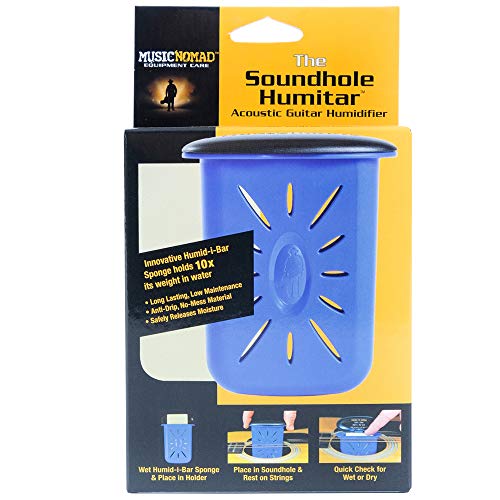
MusicNomad Humitar Acoustic Guitar Humidifier (MN300)

MusicNomad The Humitar ONE Acoustic Guitar Humidifier & Hygrometer (MN311)
BOXING 3L Top Fill Humidifier for Bedroom

BOXING 3L Humidifier with Humidistat and Auto Mode

Boveda 49% Instrument Humidifier Size 8, 10-Pack

O Oasis OH-5 Humidifier for Acoustic Guitars

Boveda 49% Guitar Humidifier Refills, 12-Ct

Afloia 1000ml/h Mist-Free Humidifier and Air Purifier
BOXING 4.5L Warm and Cool Mist Ultrasonic Humidifier

Heysland 3-in-1 Guitar Humidifier, Dehumidifier, Soundhole Cover
More On The Choices That Made The List
The MN300 is the kind of case humidifier that disappears into your routine once you set it. It hangs between the strings through the soundhole, so it works with most flat-top acoustics without crowding the body. A sponge-based refill system holds water without dripping, which matters when the case closes and shifts around in a car trunk or overhead bin.
For players who keep their guitar cased more than they gig it, this is a sensible starter. The sponge holds a noticeable amount of water, so a quick weekly re-wet is enough in most homes. Owners in consistently dry apartments tend to refill twice a week instead.
What Makes Sense
- No-mess sponge design keeps water away from the wood and labels.
- Hangs inside the soundhole, so it works in most dreadnought and concert shapes.
- Anti-drip construction is forgiving when the case gets knocked around in transit.
- Reusable rather than disposable, which keeps long-term cost down.
Points To Keep In Mind
- Needs a manual wet-and-squeeze routine every few days, depending on climate.
- Doesn’t include a built-in hygrometer, the small gauge that measures humidity.
At A Glance
Who It Suits Best
Players who keep a guitar cased at home and want a low-fuss way to steady humidity through winter.
Consider Something Else When
The MusicNomad The Humitar ONE (MN311) is the better call for anyone who wants to see the actual humidity reading without adding a separate gauge.
Where the MN300 is a workhorse, the MN311 is a workhorse with a dashboard. It combines the same sponge-based humidifier body with a built-in hygrometer, so you can glance at the case and know whether you’re sitting in the safe 40 to 50 percent range or drifting toward trouble.
For players who travel between climates, or anyone who has been burned by a cracked top before, the visible reading pays for itself in peace of mind. The case becomes a small instrument you check, not a black box you trust.
Real-World Strengths
- Combined humidifier and hygrometer in one soundhole unit.
- Visible reading means you water only when the meter actually drops.
- Reusable sponge keeps long-term ownership cost low.
- Same trusted soundhole-hung form factor as the MN300.
Honest Caveats
- The meter is mechanical, so it can take a few minutes to settle after a case opens.
- Slightly larger footprint than the MN300, which can crowd shallow-bodied guitars.
Whose Shelf It Belongs On
Players who treat humidity as a measurable problem rather than a vague worry, especially those moving between seasons or cities.
Look Elsewhere When
For a hands-off, no-monitor option, the MusicNomad Humitar (MN300) covers the same wood with a simpler refill routine.
This is the pick for the room, not the case. The 3-liter tank pours in from the top, so you don’t flip a heavy base upside down over a sink. The 20 dB sleep-mode claim (about the volume of a quiet library) keeps it out of the way at night, and the optional night light adds a soft glow without becoming a beacon.
An essential-oil tray and a 30-hour runtime make it a dual-purpose unit for anyone running a bedroom, nursery, or plant corner. Compared to the larger 4.5L Boxing model further down, this one trades tank size for a smaller footprint on a nightstand.
Strong Points
- Top-fill opening removes the awkward upside-down tank dance.
- Runs roughly 30 hours per fill at low output.
- Essential oil tray doubles it as a small diffuser.
Softer Spots
- No humidistat, so output is set by feel rather than a target number.
- Cool mist only, which feels underpowered in very dry winter rooms.
At A Glance
Made For
Bedrooms and plant rooms where a quiet, set-and-forget humidifier does the work without taking up floor space.
Swap It Out When
The BOXING 3L with Humidistat and Auto Mode is the better fit for anyone who wants a specific humidity target rather than a manual dial.
Take the previous Boxing model, add a humidistat (a sensor that reads the room’s moisture), Auto Mode, and a remote, and you land here. The unit monitors the air and ramps mist up or down to hold your chosen target, so you stop second-guessing whether the room is too wet or too dry.
The 7-color night light and timer make it feel more like a small appliance than a gadget, and the wide top-fill opening keeps cleaning simple. Compared to the Afloia further down, this one uses visible mist, which some sleepers find soothing and others find distracting.
A Strong Showing
- Humidistat with Auto Mode holds a target humidity automatically.
- Remote control is useful from bed or a desk.
- Wide top-fill opening speeds up weekly cleaning.
- Timer helps shut the unit off after the room settles.
Where It May Fall Short
- More buttons and modes than casual users may want to learn.
- Night light cycles through colors by default and needs a manual setting to lock one.
Feature Snapshot
Best Suited To
Anyone who wants to dial in a specific humidity number and let the machine do the rest, especially in mixed-use bedrooms.
Another Choice May Suit
The Afloia Mist-Free Humidifier is the better fit in rooms where visible mist or damp surfaces are a concern.
Boveda packs are the closest thing to a fire-and-forget humidifier for small instrument cases. Each foil packet holds a two-way solution that releases moisture when the air is dry and absorbs it when the air is too wet, settling around 49 percent relative humidity. The Size 8 pack is sized for narrow cases where space is the main constraint.
That’s why these land well with oboe, clarinet, flute, and violin or bow owners. The trade-off is that they’re consumable. Once the pack firms up, you replace it, and a 10-pack goes faster than you’d think across a full case rotation.
Well-Handled Touches
- Pre-set 49% RH target removes any guesswork.
- Two-way action protects against both dry and overly humid conditions.
- Compact 2.75″ x 2.5″ footprint fits tight instrument cases.
- No water contact with the instrument itself.
Some Limits To Know
- Single-use packets add up over years of ownership.
- Replacement is obvious only when the pack goes hard, which means checking periodically.
At A Glance
Who Should Grab It
Players with oboes, clarinets, flutes, or string bows who want set-and-forget humidity without touching water.
Where A Sibling Pick Shines
The O Oasis OH-5 is the better call for full-size acoustic guitars in genuinely dry climates where passive packets don’t release enough.
The OH-5 Plus+ is the O Oasis answer for dry climates. The brand’s smaller OH-1 handles mild environments, but if you live in a mountain state, a desert, or anywhere the winter air sits below 30 percent, the OH-5 is the one to reach for. It holds more water and releases it steadily into the case through a soundhole-hung body.
It’s a more deliberate tool than the MusicNomad MN300 above, and it expects a bit more attention: refilling on a schedule and checking the case for any condensation if you overfill. In return, it pushes more moisture where it counts.
The Case For It
- Higher moisture output than entry-level case humidifiers.
- Same familiar soundhole-hung form for easy installation.
- Built specifically for guitars facing extreme dryness.
Factors To Consider
- Heavier and bulkier than smaller-case competitors.
- Overfilling can leave visible moisture marks on the case lining.
Right Fit For
Guitarists in dry climates who have found standard humidifiers can’t keep up with the conditions inside the case.
Not Your Match When
The MusicNomad Humitar (MN300) is the simpler, lighter pick for mild climates or travel use.
These 12-count refills slot into existing Boveda holders, including the single and double fabric sleeves, and they cover the larger instrument cases that the Size 8 packs above don’t quite fill. Same 49 percent target, same two-way action, just a bigger packet built for dreadnoughts, jumbos, and similar cases.
If you already use Boveda, this is the refill order that keeps a working set on hand. The honest read is that buying refills before holders is a common misstep, so the listing notes that fabric holders are not included.
Real Benefits
- 12-pack covers a long stretch of routine replacements.
- Fits Boveda single, double, and directional holders.
- Same trusted 49% two-way moisture control.
Practical Considerations
- Requires a separate Boveda holder to function.
- Consumable, so ongoing cost adds up across multiple guitars.
At A Glance
Who Will Love This
Existing Boveda users with larger guitars who need a steady supply of replacement packs.
Skip It When
You don’t already use Boveda holders, in which case the O Oasis OH-5 is a better starting point for a single guitar.
Afloia takes a different route. Instead of a fine mist plume, it uses evaporative airflow to push moisture into the room. That means no visible cloud, no white dust on nearby furniture, and no damp patch under the unit. A four-way airflow design helps the moisture spread more evenly than older top-blowing styles.
The combined filtration role (the brand markets it as humidifier and air purifier) is useful in bedrooms where dust and pet dander already circulate. The honest read is that 1000ml/h is the listed top output, and real-world rates depend on room humidity, so dry winter rooms may need it on higher settings for longer stretches.
Advantages To Know
- Mist-free operation avoids the wet-floor problem common to ultrasonic units.
- Four-way airflow spreads moisture more evenly than a single outlet.
- Combined humidifier and filtration function trims device clutter.
Where It Is Less Suited
- Filter replacements add an ongoing maintenance cost.
- Output drops as the wick filter ages, so older units may need longer runtimes.
Perfect Match For
Bedrooms and nurseries where a quiet, no-mist unit is more important than a large tank.
A Better Fit Elsewhere
The BOXING 4.5L Warm and Cool Mist Humidifier is the better pick for very dry winter rooms that need long runtime and visible output.
The big sibling in the Boxing room-humidifier line trades compactness for reach. A 4.5L tank pushes runtime out to around 45 hours on lower settings, and warm-mist output is the practical upgrade over the cool-mist 3L models earlier in this list. Warm mist feels more comfortable in cold bedrooms and helps the moisture disperse faster in dry winter air.
It also adds a humidistat, auto shut-off, remote, and timer, which together make the unit feel closer to a year-round appliance than a seasonal helper. The trade-off is size: a 4.5L reservoir on top takes up meaningful nightstand real estate.
What It Does Well
- Warm and cool mist options cover both summer and winter rooms.
- Up to 45 hours of runtime per fill on lower settings.
- Humidistat, auto shut-off, and timer add day-to-day safety and convenience.
Trade-Offs To Consider
- Larger footprint than 3L alternatives, which may crowd small nightstands.
- Warm-mist heating element uses more power than cool-mist-only units.
At A Glance
Built With In Mind
Large bedrooms or open living spaces where a smaller humidifier would run dry before morning.
Reach For A Different Pick When
The BOXING 3L Top Fill Humidifier is a tighter fit for small rooms and tight nightstands.
Most case humidifiers do one job. The Heysland unit handles three: it acts as a humidifier with a moistened sponge, a dehumidifier using an included desiccant, and a passive soundhole cover that helps tame unwanted feedback when a guitar is plugged in. The design fits soundholes between 100 and 103 mm, so it’s worth measuring before ordering.
For studio players and frequent travelers, the multi-mode approach is genuinely useful, since the same climate swing that requires humidity at home can flip to damp in a basement studio. The honest read is that switching modes means swapping the inserts, which is a small extra step.
The Good Stuff
- Three functions in one soundhole insert.
- Soft rubber edge protects the finish around the soundhole.
- Useful feedback control when a guitar is amplified on stage.
Where It May Fall Short
- Limited to guitars with 100 to 103 mm soundholes, so check the measurement.
- Switching modes means swapping the sponge for the desiccant manually.
Who Should Grab It
Studio players and travelers whose humidity conditions swing between very dry and very damp.
A Better Fit Elsewhere
The MusicNomad Humitar (MN300) is the simpler call for players who only ever need one-way moisture control.
What To Weigh Before Picking Acoustic Humidifiers
Match The Humidifier To The Job
Start with a clear question: are you protecting an instrument inside a case, or balancing the humidity in a room? Case humidifiers from MusicNomad, Boveda, O Oasis, and Heysland work in tight enclosed spaces and target the 40 to 50 percent range. Room humidifiers from Boxing and Afloia push moisture into open air and matter more for skin, sinuses, and wood furniture than for the guitar itself. The two categories don’t replace each other, and serious players often end up using both.
Sizing And Runtime For Rooms
Room humidifier sizing comes down to two numbers: tank capacity and target room size. A 3L tank covers most bedrooms for a couple of nights per fill, while a 4.5L tank is more practical for open-plan spaces or homes with wood floors that need steady moisture. Top-fill designs (a tank you pour water into from the top) are noticeably easier to maintain than units you have to flip upside-down over a sink, and a wide opening makes weekly cleaning faster.
Materials And Long-Term Care
For case humidifiers, the material inside the water reservoir matters more than the housing. Sponges and fabric holders need replacement or rinsing on a schedule, and the brand’s refill cadence (every few days for sponges, every few months for Boveda packs) shapes the long-term cost. BPA-free plastics on room units matter if the humidifier runs near a sleeping child or in a kitchen. Ultrasonic models benefit from regular descaling, the process of dissolving mineral buildup, in hard-water areas where the listed runtime is shorter than the tank suggests.
Key Considerations Across These Picks
Where Shoppers Go Wrong
A common mistake is buying a room humidifier and assuming the guitar is covered. It isn’t: an open room at 45 percent relative humidity still lets a cased guitar drop into the 20s in dry winter air. Another is skipping the measurement on soundhole-fitting units like the Heysland, only to find the insert doesn’t sit right. Finally, owners sometimes forget that consumable humidifiers, including Boveda packs, have a finite life, and a hard pack stops protecting long before it looks broken.
Where The Extra Money Goes
Stepping up from a basic case humidifier to a feature-rich model usually pays for either measurement, automation, or output. A built-in hygrometer tells you when to refill instead of guessing. A humidistat and Auto Mode hold a target without constant adjustment. Higher-output units like the O Oasis OH-5 keep up in climates where smaller humidifiers run out of water mid-week. For most players, the upgrade is worth it the first time the room or climate pushes past moderate.