


A damp closet, a muggy bedroom, a basement that never quite dries out: moisture problems show up in small, stubborn ways. The right dehumidifier pulls that extra humidity out of the air without dominating the floor space or your electric bill. After comparing seven compact and mid-sized options, these picks cover everything from 280-square-foot bedrooms up to larger 2,500-square-foot basements. Whether you need whisper-quiet operation for sleeping or stronger extraction for a musty utility room, there’s a sensible match below.
An Overview Of The Picks

PLUSCENT 21 Pint Dehumidifier for Basement and Home

PSOS 98 OZ Dehumidifier for Home (Gray)

FreAire 34 Pint Dehumidifier for 2500 Sq.Ft

QFOX 2000 Sq.Ft Rotary Dehumidifier with Drain Hose

TABYIK 35 OZ Dehumidifier for Bedroom RV (Grey)

TABYIK 35 OZ Dehumidifier for Bedroom RV (Blue)
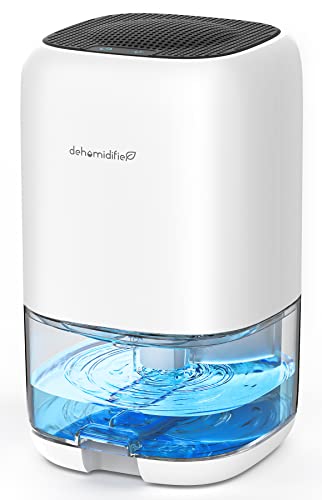
TABYIK 35 OZ Dehumidifier for Bedroom RV (White)
More Details On Our Top Picks
The PLUSCENT 21 Pint Dehumidifier sits in a comfortable middle ground, sized for rooms up to 1,500 square feet without taking over the corner it’s parked in. Its 160W compressor system pulls up to 21 pints of moisture per day, which covers a damp basement, a humid bedroom, or even a closed-up RV after a rainy weekend.
Unlike the small Peltier (thermoelectric cooling) units coming up later, this one uses traditional compressor dehumidification, so it actually works when room temperatures climb. Setup is straightforward, and the included drain hose means you can route water out continuously instead of emptying a tank every few hours.
The Upside
- Compressor-based extraction handles warm, sticky rooms better than Peltier alternatives
- Continuous drain option removes the daily tank-emptying chore in basements or laundry rooms
- 1,500 sq. ft. coverage suits medium basements, open-plan living areas, and upstairs bedrooms with chronic humidity
- Mobility is reasonable thanks to a compact cabinet and built-in handle for moving between rooms
Things To Consider
- Compressor noise is louder than Peltier designs, so bedroom placement may bother light sleepers
- The 21-pint rating is measured at 95°F/90% RH, so real-world output drops in cooler basements
- Tank-only operation requires manual draining when the hose isn’t connected, which owners commonly report as the main upkeep task
Key Specs
Right Fit For
Homeowners dealing with a consistently damp basement, large bedroom, or multi-room space up to 1,500 square feet who want compressor-level extraction without a commercial-sized unit.
Where Another Pick Suits Better
Light sleepers running a unit on a nightstand should consider the TABYIK 35 OZ Dehumidifier for Bedroom RV (Grey) instead, since its Peltier design runs much quieter at the cost of coverage area.
PSOS takes a Peltier-style approach with dual semiconductor condensation, which is a heat-pump-free design that runs cool and quiet. The 98-ounce tank means fewer trips to the sink, and the integrated humidity display lets you dial in a target without guesswork.
Where the PLUSCENT leans into raw extraction, this one trades some pulling power for a softer acoustic profile, making it a sensible fit for nurseries, home offices, and small living rooms where conversation or sleep matters. The 7-color ambient light is a small touch, but useful as a nighttime indicator.
Strong Points
- Two operating modes let you choose between quiet background drying and stronger extraction during the day
- Digital humidity readout removes the need for a separate hygrometer
- Auto shut-off prevents overflow once the 98 oz tank fills, a common safeguard in bedrooms
- Compact cabinet slides under most side tables or into a closet corner
Worth Noting
- Semiconductor cooling slows down significantly once room temperature drops, so chilly basements aren’t its strength
- The 1,000 sq. ft. claim assumes a closed environment; open layouts will see less impact
Who It Suits Best
Studio apartment dwellers, light sleepers, and home office workers who want a near-silent unit with a visible humidity readout in rooms around 1,000 square feet or less.
Look Elsewhere When
You need serious pulling power for a 2,000+ sq. ft. basement, in which case the FreAire 34 Pint Dehumidifier is a much better match.
FreAire’s 34-pint compressor system steps up to larger basements and whole-floor living areas. Rated for spaces up to 2,500 square feet, it pulls up to 34 pints per day at 95°F and 90% relative humidity, which is a meaningful jump from mid-size options.
Compared to the PLUSCENT covered earlier, the larger extraction rate and longer drain hose (6.56 ft) make this one better suited to serious moisture problems. It’s the kind of unit that earns its keep after a flood scare or in chronically damp below-grade spaces.
Reasons It Performs
- 34-pint daily extraction tackles stubborn basement dampness that overwhelms smaller units
- 6.56 ft drain hose offers flexible routing to floor drains or sump pump areas
- 2,500 sq. ft. coverage covers large finished basements and open-concept main floors
- Adjustable humidistat allows target humidity settings instead of guess-and-check operation
Trade Offs
- Larger cabinet footprint, so it needs a dedicated corner or utility-room placement
- Compressor noise is noticeable, especially in open layouts adjacent to living areas
Quick Facts
Made For
Homeowners with a 1,500 to 2,500 sq. ft. basement, large finished lower level, or chronically damp crawlspace conversion who need serious daily extraction and a continuous-drain setup.
Skip It When
You’re only trying to manage a single small bedroom, in which case the TABYIK 35 OZ Dehumidifier for Bedroom RV (Blue) keeps the room comfortable at a fraction of the size and cost.
QFOX uses a desiccant rotary wheel rather than a compressor, which is a fundamentally different approach that actually performs better in cooler rooms where compressor-based units lose efficiency. Rated for up to 2,000 sq. ft. and 101 oz of daily extraction at 86°F/80% RH, it fits a specific niche.
That technology tradeoff matters in unheated basements, three-season rooms, and RVs where temperatures drop below the threshold where traditional dehumidifiers shine. The 2.5L tank plus drain hose gives you both options, and the 7-color ambient light adds a soft visual cue for low-light placement.
Everyday Perks
- Desiccant rotary design keeps extracting moisture in cooler rooms, unlike compressor units that slow down below 65°F
- Sleep mode reduces fan noise for bedrooms and nurseries
- 2,000 sq. ft. coverage suits mid-size basements and large RVs alike
- Drain hose and 2.5L tank support either continuous or manual operation
Room For Improvement
- Desiccant wheels tend to use more wattage per pint than compressor units, so energy-conscious users may notice the bill
- Extraction rate of 101 oz per day is measured at 86°F/80% RH, so hotter or drier conditions reduce output
Best Suited To
Owners of cool basements, garages, and RVs where compressor dehumidifiers lose efficiency, plus anyone wanting a quieter alternative to a traditional compressor in mixed-temperature living areas.
Not Your Match When
You’re drying out a hot, humid southern basement above 80°F; the FreAire 34 Pint Dehumidifier’s compressor design handles that scenario more efficiently.
TABYIK’s 35 oz Peltier unit slips into spaces where a compressor dehumidifier simply won’t fit. Rated at 28 dB on its quietest setting, it tucks onto a nightstand, a bathroom shelf, or a closet floor without disrupting sleep, and it consumes less than 1 kWh per day based on manufacturer figures.
Daily extraction tops out at around 16 oz in a closed 86°F/80% RH environment, so this is honest about being a small-room tool. Think bedroom, RV cabin, walk-in closet, or home office, not a finished basement.
Real-World Strengths
- 28 dB operation is genuinely bedroom-friendly, even for light sleepers
- 35 oz tank capacity outlasts smaller Peltier units between emptyings
- Sub-1 kWh daily energy draw keeps operating costs minimal
- Auto shut-off protects the unit when the tank fills overnight
Points To Note
- 280 sq. ft. coverage ceiling means it struggles in large open living areas
- Peltier cooling slows dramatically in cold rooms, so unheated winter spaces aren’t a fit
- 16 oz daily extraction won’t keep up with a serious moisture problem like a flooded basement
Perfect Match For
Apartment renters, RV travelers, and small-bedroom dwellers who need a near-silent, low-energy unit for enclosed rooms under 300 square feet.
Another Choice May Suit
Anyone with a mid-size room up to 1,000 sq. ft. who wants quieter operation than a compressor will appreciate the PSOS 98 OZ Dehumidifier for Home (Gray) instead.
Functionally identical to the grey TABYIK covered above, this blue variant exists for shoppers who care how the unit looks on a shelf. The 35 oz tank, 28 dB noise floor, and 280 sq. ft. coverage are all the same, which means the decision comes down to aesthetic match and room decor.
It’s a sensible pick for a child’s bedroom, a guest room, or anywhere you want a color-coordinated appliance instead of a generic white box. For shoppers comparing this to the white version later in the list, the underlying performance is interchangeable.
A Favorable Mix
- Blue finish blends into playrooms, kids’ bedrooms, and accent-colored spaces better than white or grey
- Same 28 dB quiet operation as the grey model, suitable for nightlight-side placement
- 7-color ambient light offers mood lighting alongside the moisture-removal function
- Auto shut-off at tank-full prevents overnight overflow on dressers and nightstands
Soft Spots
- 280 sq. ft. coverage limit rules out open-plan living areas
- Peltier cooling drops in efficiency below 59°F, limiting cold-room usefulness
Who Should Grab It
Anyone decorating a kid’s room, guest bedroom, or color-themed space who wants the same quiet performance as the grey TABYIK but in a brighter finish.
Swap It Out When
You need a larger tank and a humidity display, in which case the PSOS 98 OZ Dehumidifier for Home (Gray) offers a built-in readout and nearly triple the tank capacity.
The white TABYIK rounds out the trio as the neutral-finish option. It runs on the same Peltier platform as its grey and blue siblings, which means the same 35 oz tank, the same 28 dB operation, and the same 280 sq. ft. ceiling. For most small bedrooms and bathrooms, that footprint is the right size.
Like the other TABYIK models, extraction peaks at about 16 oz per day in closed 86°F/80% RH conditions, and energy use stays below 1 kWh daily. The white cabinet disappears into most interiors, which is exactly the point of a small, quiet dehumidifier you barely notice.
Useful Highlights
- White finish suits bathrooms, laundry rooms, and minimalist bedrooms where grey or blue would clash
- 28 dB operation is genuinely quiet for nighttime use in small rooms
- Auto shut-off prevents spills when the 35 oz tank fills, a useful safeguard in unattended placement
- Compact cabinet fits on vanities, counters, and closet shelves without dominating the space
Honest Caveats
- Same 280 sq. ft. coverage as the other TABYIK units, so it won’t handle open layouts
- Cooler rooms below 59°F reduce extraction noticeably, limiting winter utility in unheated spaces
- Tank needs emptying roughly every 1 to 2 days in humid conditions, depending on room size
Whose Shelf It Belongs On
Anyone outfitting a bathroom vanity, a small bedroom, or a closet with a low-noise, low-energy unit in a neutral white finish that blends into the room.
Where A Sibling Pick Shines
Color-conscious shoppers decorating a themed bedroom may prefer the blue TABYIK 35 OZ Dehumidifier for Bedroom RV, since the underlying performance is identical.
What To Weigh Before Choosing Small Space Dehumidifiers
Match Coverage To Room Size
The single biggest mistake is buying a unit rated for far more or far less square footage than the actual room. A 280 sq. ft. Peltier unit running constantly in a 1,500 sq. ft. basement will never catch up, while a 34-pint compressor in a small closet wastes energy and adds noise. Measure the room, then pick the closest coverage range.
Pick The Right Technology For The Temperature
Compressor dehumidifiers extract more moisture per kilowatt in warm rooms above 65°F, but slow down in cooler spaces. Peltier and desiccant rotary units keep working in cooler temperatures, which matters in unheated basements, garages, and RVs. Choosing the wrong type for the room temperature is a common reason people think their dehumidifier “doesn’t work.”
Decide On Tank Versus Continuous Drain
Small Peltier units rely on manual tank emptying, which adds upkeep. Compressor models often include a continuous drain hose for unattended operation. For a closet or bathroom, manual emptying is fine. For a basement, continuous drainage removes a recurring chore.
Key Considerations Across These Picks
Pitfalls Shoppers Hit
Choosing by tank size alone is tempting, but a bigger tank only matters if extraction rate is high enough to fill it. A 98 oz tank on a slow Peltier unit still needs frequent emptying, while a smaller 35 oz tank on a powerful compressor in a humid basement may overflow without a drain hose. Match tank capacity to the unit’s actual pulling power, not the headline number.
Where The Extra Money Goes
Higher-tier models in this category typically add a digital humidistat, a continuous drain option, and stronger compressor components built for daily use. The upgrade pays off for basements and large rooms where the unit runs for hours. For a single small bedroom, a basic Peltier model handles the job without the extra spend.
Frequently Asked Questions
How big of a dehumidifier do I need for a small bedroom?
A Peltier unit rated for around 280 sq. ft., such as the TABYIK models, fits most bedrooms up to roughly 12 by 12 feet. Larger bedrooms benefit from a unit rated closer to 500 sq. ft.
Where should a small dehumidifier be placed in a room?
Place it a few feet off the wall, away from furniture that blocks airflow. Keep it off rugs, which can trap moisture underneath, and avoid direct sunlight or heating vents that distort the humidity reading.
How often does the water tank need emptying?
A 35 oz Peltier tank in a humid bedroom typically needs emptying every one to two days. A 98 oz tank on a stronger unit may run three to four days. Continuous drain hoses eliminate the task entirely.
Can a small dehumidifier run all night?
Peltier units at 28 dB are designed for overnight bedroom use, and most include auto shut-off when the tank fills. Compressor models are louder and may disturb light sleepers.
Do dehumidifiers work in cold rooms?
Compressor units slow down below 65°F, while desiccant rotary and Peltier units keep extracting at lower temperatures. For unheated basements or winter RV use, a desiccant rotary model is the more reliable choice.
Closing Remarks
The right dehumidifier depends less on the brand name and more on matching technology, capacity, and coverage to the actual room. For a damp basement, the FreAire or PLUSCENT units deliver the pulling power you need. For a bedroom or RV, the TABYIK trio keeps things quiet and compact. Measure the room, check the temperature, and pick the unit whose strengths line up with your situation.