


A humidity gauge is one of those quiet tools that pays off the moment you plug in a dehumidifier, store a wooden instrument, or notice a musty smell creeping into a closet. The right unit turns vague discomfort into a number you can act on, helping you dial in a nursery, protect a gun safe, or simply confirm that a basement dehumidifier is actually doing its job. Across these eight options, the spread runs from single-room LCD sticks to multi-pack room kits and a Bluetooth-connected sensor with app history. Use this shortlist to match the format and feature set to the space you’re trying to manage.
The Shortlist At A Glance

Protmex HT607 Temperature Humidity Meter with Backlight

Hornady 95909 Digital Hygrometer for Gun Safes
X-Sense Wi-Fi Thermometer Hygrometer with LCD
Geevon 2-Pack Mini Digital Hygrometer with Time Display
Geevon 4-Pack Mini Indoor Thermometer Hygrometer with Comfort Indicator

Geevon 6-Pack Mini Indoor Thermometer Hygrometer with Comfort Indicator

Geevon 6-Pack Mini Digital Hygrometer with Comfort Index

SwitchBot Bluetooth Thermometer Hygrometer with App Control (2-Pack)
Inside Each Recommended Option
The Protmex HT607 is the closest thing on this list to a bench instrument. It reads ambient temperature, relative humidity, wet-bulb, and dew point from a single probe, which makes it useful when a plain indoor number is not enough. A backlit LCD and a slide-on cover protector suit a workshop shelf or a tool drawer where the unit may get knocked around.
Where the Hornady touchscreen sticks to one indoor spot, the HT607 is built to travel between rooms and job sites. It suits a DIYer chasing moisture in a crawlspace one afternoon and a guitar one evening. For most living rooms, the extra modes will sit unused, but the responsive sensor and clear readout earn their place on the list.
Key Advantages
- Four measurement modes cover wet-bulb and dew point beyond basic humidity
- Backlight and cover protector make it readable in dim crawlspaces and safe in a toolbox
- Handheld form factor suits a homeowner moving from basement to attic
- Strong anti-interference sensor is well suited to workshop environments with motors or fluorescent lighting
- Works as a spot-check tool wherever a permanent wall gauge is not practical
Worth Noting
- Larger footprint than the mini-stick Geevon units, so it stands out on a small shelf
- Not designed as a set-and-forget wall monitor; it is a tool you pick up, not one you glance at
- Some owners prefer AAA-powered dedicated room units for long-term placement
Key Specs
Right Fit For
Owners who want a diagnostic tool rather than a passive room display, including workshop users and serious DIYers.
Look Elsewhere When
Anyone wanting a discreet, always-visible room monitor is better served by the Geevon 4-Pack Mini Indoor Thermometer Hygrometer with Comfort Indicator.
The Hornady 95909 is purpose-built for enclosed storage spaces where rust and moisture are real concerns. Its touchscreen LCD shows current readings along with high and low memory, and a fold-out stand plus a quick-connect bracket let you set it on a shelf or mount it to an interior safe door. The unit is compact at roughly 5 by 3 inches, which is friendly to small safe interiors.
Where the Protmex HT607 is a wandering diagnostic, the Hornady stays put. A 24-hour high/low indicator gives a useful trace of how conditions drift overnight, which matters for long-term firearms and document storage. It runs on two AAA batteries, so the cabinet stays clean of cords, and the included mounting options make the first install painless.
The Case For It
- Touchscreen display is simple to operate inside a dim safe
- 24-hour high/low memory tracks overnight drift in humidity and temperature
- Includes both a fold-out stand and a wall or door-mount bracket
- Compact body fits the interior shelf of most full-size safes
- Switchable Fahrenheit and Celsius reading
Trade Offs
- Batteries are not included in the box
- Single-device format means each separate safe or closet needs its own unit
- Lacks wireless or app reporting, so you only see conditions when you open the door
Who It Suits Best
Safeguards for firearms, optics, and paper records who want a simple, set-and-check humidity gauge inside an enclosed cabinet.
Where Another Pick Suits Better
For whole-home monitoring with phone alerts, the X-Sense Wi-Fi Thermometer Hygrometer with LCD covers more ground from a single dashboard.
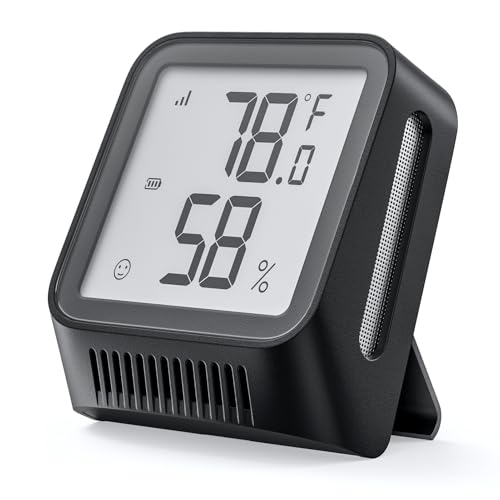
The X-Sense sensor pushes readings to your phone over Wi-Fi, which changes the daily experience of owning a humidity gauge. You can glance at the nursery from the office, get an alert when a basement spikes after a storm, or check a greenhouse without stepping outside. The local LCD still gives an at-a-glance number for anyone standing in the room.
The catch is that the sensor itself only works as part of the wider X-Sense ecosystem. A base station is required to access the app features, and that base is sold separately. Compared with the Hornady touchscreen, this is a smarter but less self-contained option, and you may find the extra hub worth it for the remote alerts.
Useful Strengths
- Wi-Fi connectivity means remote monitoring from anywhere with a phone signal
- LCD on the unit gives an at-a-glance local reading
- Useful for basement leak detection where early warnings prevent damage
- Plays well with other X-Sense safety and air-quality devices
Practical Considerations
- Requires a separate X-Sense base station to unlock the app and alerts
- Adds setup steps versus a battery-only stick-on unit
- Wi-Fi range and home network reliability directly affect how dependable alerts feel day to day
Made For
Smart-home households who already use phone alerts for cameras, leak sensors, or smoke alarms and want humidity data in the same app.
Consider Something Else When
Anyone looking for a single room gauge with zero hub setup is better matched by the Geevon 2-Pack Mini Digital Hygrometer with Time Display.
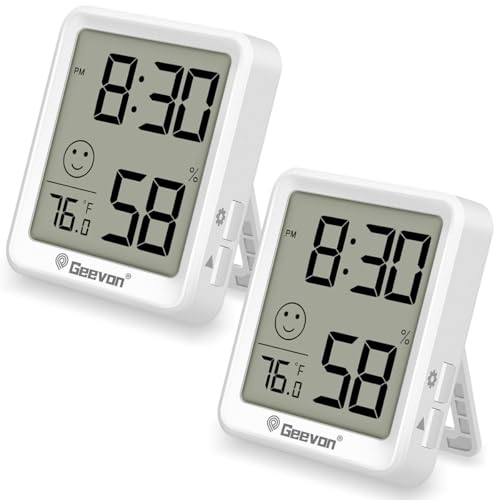
The Geevon two-pack covers the most common household need, which is a humidity gauge for the bedroom and one for the home office, without overbuying. The 1.9-inch LCD shows temperature, humidity, and a built-in comfort icon that tells you at a glance whether the air sits in a dry, comfortable, or wet band. A time display is built in, so the unit can also pull double duty on a nightstand.
It measures from roughly minus 22 to 158 degrees Fahrenheit and 1 to 99 percent relative humidity, which covers virtually any climate-controlled room. The single button cycles between Celsius and Fahrenheit, an easy win for shared spaces. Compared with the Hornady touchscreen, this is less of a precision instrument and more of an everyday wall companion.
Well-Handled Touches
- Compact body fits on a shelf, desk, or mounted on a wall
- Comfort-level icon makes the readings accessible to kids or seniors
- Time display adds useful function on a bedside table
- Two-pack pricing is friendly to small apartments and starter homes
- Wide measurement range handles basement, attic, and outdoor-shed placements
Minor Gripes
- Display is functional rather than premium, so glare in direct sun can be an issue
- No high/low memory, so you only see the current reading
Best Suited To
Couples, roommates, or small households who want one reading in the main bedroom and one in a work area without committing to a multi-pack.
A Better Fit Elsewhere
For a four-room sweep, the Geevon 4-Pack Mini Indoor Thermometer Hygrometer with Comfort Indicator gives broader coverage at a similar per-unit cost.
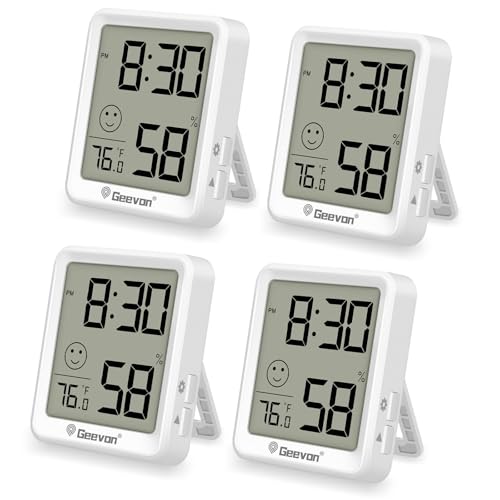
The Geevon four-pack is the practical sweet spot for most households. You can place a unit in the living room, nursery, basement, and garage and instantly see that the basement is fine while the nursery runs dry in winter. The same 1.9-inch LCD, comfort icon, and time display appear on every device, so there is no learning curve once the first one is set.
Where the Hornady 95909 is focused on one enclosed cabinet, the four-pack assumes you want a snapshot of conditions across the entire home at the same moment. The trade-off is that these are independent units, so they do not talk to each other or report to an app. You walk around and read them, which for many households is exactly the right amount of data.
Where It Helps
- Four units cover a typical single-family home’s main living zones
- Comfort icon gives non-technical household members an easy read
- Time display and Celsius/Fahrenheit toggle add everyday utility
- Same compact form factor as the two-pack, so placement is flexible
- Each unit operates independently, no hub or app required
Points To Note
- Units do not sync, so you compare rooms by eye rather than through an app
- Accuracy is suited to everyday use rather than laboratory calibration
Who Will Love This
Families managing a nursery, a basement dehumidifier, and a workshop who want a quick walk-through reading in each space without any app setup.
Skip It When
Anyone who prefers a single dashboard with trend graphs is better matched by the SwitchBot Bluetooth Thermometer Hygrometer with App Control (2-Pack).
The Geevon six-pack targets a larger home, a small office, or anyone who treats humidity like a per-room project. With six identical units you can monitor living areas, bedrooms, the basement, the garage, a wine cellar, and a greenhouse without swapping devices around. The same 1.9-inch LCD, comfort icon, and time display carry over from the smaller packs.
For most households this is more coverage than needed, and the surplus can sit in a drawer until a room is added. The honest read is that the per-unit cost beats buying singles later, so the six-pack tends to suit planners. If you only need two or three rooms, the four-pack above is the leaner choice.
What Makes Sense
- Six units suit larger homes, multi-room offices, or shared rental properties
- Comfort-level icon keeps the format simple across every room
- Time and temperature display work as a desk or shelf clock as well
- Per-unit cost is friendlier than the two-pack once you need this much coverage
- No pairing or hub setup; each unit stands alone
Soft Spots
- Overkill for studios and small apartments
- Owners report keeping spare units in storage since one per room covers a lot of ground
Perfect Match For
Property managers, larger households, and home office setups with several enclosed spaces that each need a reading.
Another Choice May Suit
Studio dwellers and small apartments get everything they need from the Geevon 2-Pack Mini Digital Hygrometer with Time Display.
The Geevon comfort-index six-pack swaps the time display for a happy or sad face indicator, which doubles as a quick “is the room okay” cue. The face turns dry, comfort, or wet based on the current reading, which is genuinely useful in a nursery or a senior’s bedroom where someone may not want to interpret a number. Six units give you the same wide coverage as the previous six-pack.
The sensor tracks the same minus 22 to 158 degree Fahrenheit and 1 to 99 percent humidity range, refreshing every fifteen seconds. Compared with the Hornady touchscreen’s precision focus, this is a friendlier, more visual approach. You trade the time readout for the comfort face, so it depends on which feature your household would actually use.
Advantages To Know
- Happy/sad comfort face simplifies the read for children and seniors
- Six units cover a larger home or a small business without buying singles
- Single button cycles Celsius and Fahrenheit, friendly to shared spaces
- Refreshes roughly every fifteen seconds, so changes register quickly
- Compact body fits nightstands, counters, and greenhouse shelves
Points To Keep In Mind
- No time or clock readout, unlike the sibling Geevon packs
- Humidity accuracy is rated plus or minus five to ten percent, so treat the face as a guide rather than a lab reading
Who Should Grab It
Nurseries, playrooms, and shared living spaces where a quick visual cue is more useful than a clock readout.
Reach For A Different Pick When
Anyone who wants a clock on the same device is better served by the Geevon 2-Pack Mini Digital Hygrometer with Time Display.
The SwitchBot two-pack is built around data. A Swiss-made sensor reports temperature and humidity in tight tolerances, and the readings stream to your phone over Bluetooth, where you can chart history, export logs, and set alerts when a room drifts out of range. For a greenhouse, a humidor, or a recording studio, that trend line is the real product.
The catch is Bluetooth range, which usually means you check readings when you’re on the same Wi-Fi network or nearby with your phone. The large LCD still gives a quick local number, so the device earns its keep even when the phone is in another room. Compared with the X-Sense Wi-Fi option, this trades remote-anywhere access for a smaller hub footprint and tighter accuracy claims.
Everyday Advantages
- Tight temperature and humidity tolerances from a Swiss-made sensor
- App history and data export support greenhouse, humidor, and lab-style tracking
- Push alerts when a room goes out of range
- Large LCD for at-a-glance local reading without opening the app
- Two-pack covers a primary and a secondary space, such as a bedroom and a basement
Honest Caveats
- Bluetooth range is shorter than Wi-Fi, so remote-anywhere monitoring is limited
- Most useful when paired with the SwitchBot app ecosystem
Key Specs
Whose Shelf It Belongs On
Data-driven users who want history graphs and alerts, including greenhouse growers, cigar humidor owners, and home studio operators.
Swap It Out When
Anyone wanting long-range remote alerts over a home network will find the X-Sense Wi-Fi Thermometer Hygrometer with LCD a better fit.
Choosing a Humidity Gauge That Actually Helps
A humidity gauge is only as useful as the room you put it in. Start with where you’ll place it, since a gun safe wants a compact, set-and-forget unit like the Hornady 95909, while a basement wants a Wi-Fi sensor with phone alerts such as the X-Sense, so a leak wakes you up before the carpet does. If you’re a beginner and just want to know whether the air feels right, a Geevon comfort-face unit is a gentle on-ramp.
Accuracy claims matter, but match them to the decision you’ll make with the number. A plus or minus five percent reading is enough to tell you to run a dehumidifier, while a greenhouse or humidor benefits from a tighter sensor like the SwitchBot’s. A multi-room home is often better served by a four-pack or six-pack than by one expensive device, since conditions vary more by room than by sensor.
Placement is its own decision. Mount a unit on an interior wall, away from direct sunlight, kitchens, and bathroom doors, so it reads the room rather than a local draft. For outdoor sheds and greenhouses, look for a wider temperature range, since most mini-sticks are built for indoor air and can struggle at the extremes. The right gauge disappears into your routine, and you only notice it when conditions drift, which is exactly the point.
What to Watch for Before You Buy
Common Shopping Slip Ups
The most common mistake is buying a single premium gauge and expecting it to describe the whole house. Humidity varies room to room, so a basement, a nursery, and a living room each benefit from their own reading. Another pitfall is choosing a Wi-Fi sensor without checking whether a hub is required, since some units only unlock the app once a base station joins the network. Placement also catches first-timers off guard, since direct sunlight or a nearby kitchen vent can throw a reading off by ten percent or more.
When Paying More Pays Off
Spending up usually buys three things in this category. The first is a tighter sensor, which matters for greenhouses, humidors, and recording studios where a five-percent swing is the difference between healthy and damaged. The second is connectivity, since Wi-Fi or Bluetooth adds remote alerts, history graphs, and the ability to spot a slow leak from your phone. The third is build quality, including a sturdier body, a more legible LCD, and a mounting kit that holds up over time. For a single-room read at home, a basic Geevon is plenty. For data, alerts, or specialty storage, the upgrade earns its keep.
Frequently Asked Questions
Where should a humidity gauge be placed for the most accurate reading? Mount it on an interior wall at roughly eye level, away from direct sunlight, kitchens, and bathroom doors. The goal is to read the room’s general air rather than a draft or a heat source.
What humidity level is comfortable indoors? Most people feel comfortable between 30 and 50 percent relative humidity, with around 45 percent often cited as a balanced target. Below 30 percent, skin and sinuses dry out, and above 60 percent, dust mites and mold risk climb.
Do humidity gauges need calibration? Most consumer units arrive factory-calibrated to a reasonable tolerance, and a periodic cross-check against a known reference is enough. Specialty environments like a humidor benefit from a tighter sensor, such as the SwitchBot, and more frequent spot-checks.
Can one humidity gauge monitor multiple rooms? Not reliably, since conditions vary room to room, which is why multi-packs like the Geevon four- and six-packs exist. A single Wi-Fi sensor with a base station, such as the X-Sense, can also pair multiple remote units into one dashboard.
How often should batteries be replaced? Battery life varies with display type and connectivity, but most mini-sticks run for many months on a fresh set. Bluetooth and Wi-Fi units use more power, so checking battery status in the companion app once or twice a year is a sensible habit.
The Takeaway
A good humidity gauge is less about fancy features and more about the right unit in the right room, with a sensor accurate enough for the decision you need to make. Match the format to the space, place it away from drafts and sunlight, and you’ll stop guessing about your air. Pick the one that fits your home, and let the numbers do the rest.