


A small room can turn into a humidity trap faster than most people expect. Steam from a bathroom, a tightly sealed bedroom, or a closet tucked against an exterior wall all create the kind of damp that lingers in fabrics, electronics, and wooden furniture. A compact dehumidifier pulls that moisture from the air before it turns into musty smells, condensation on windows, or warped shelving.
You don’t need a heavy-duty whole-home unit to fix a small space. A properly sized machine, set up with the right tank or drain path, does the job quietly and without the energy cost of a basement workhorse. The picks below cover compact Peltier-style units for bedrooms and bathrooms, mid-size compressor models for wider living areas, and continuous-drain options for those who never want to think about emptying a tank.
The Leading Options At A Glance

PLUSCENT 21 Pint Dehumidifier for Basement and Home

PSOS 98 OZ Dehumidifier for Home (Gray)

FreAire 34 Pint Dehumidifier for 2500 Sq.Ft

TABYIK 35 OZ Small Dehumidifier for Bedroom (Grey)

TABYIK 35 OZ Small Dehumidifier for Bedroom (Blue)

TABYIK 35 OZ Dehumidifier for Bedroom RV (Gold)
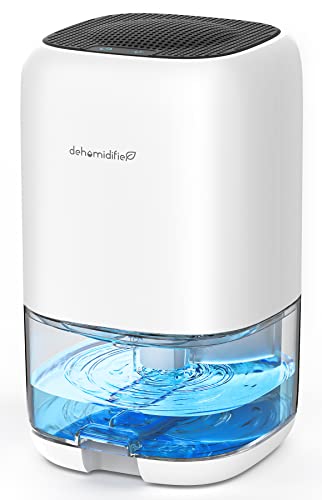
TABYIK 35 OZ Dehumidifier for Bedroom RV (White)
The Details Behind The Selections
The PLUSCENT 21 Pint covers the awkward middle of the market: bigger than a desktop Peltier unit, smaller than the industrial basement boxes. Rated for spaces up to 1,500 sq. ft., it fits comfortably in finished basements, large bedrooms, or open-plan living areas where humidity builds up from cooking and shower steam.
A 160W compressor system pulls up to 21 pints of moisture per day at 95°F with 90% relative humidity, and a built-in drain hose port means you can route the condensate to a floor drain and skip the daily empty. For shoppers in coastal climates or older homes without dedicated HVAC dehumidification, that continuous-drain option is the reason to pick this over a smaller unit.
Everyday Perks
- Handles larger open areas up to 1,500 sq. ft., so a single unit can cover a finished basement without needing a second machine.
- Continuous-drain compatibility means you can set it up near a floor drain and stop thinking about tank emptying.
- Compressor-based extraction pulls moisture faster than Peltier models, which matters in genuinely damp rooms.
Things To Consider
- Compressor models run warmer and louder than the Peltier units further down this list, so a quiet bedroom placement may be noticeable.
- 21-pint capacity is a strong daily figure, though in poorly insulated basements you may see the tank fill before the day is over without a drain hose attached.
- The unit’s size and weight make it a more permanent placement than the grab-and-go bedroom models.
Who It Suits Best
Homeowners with a finished basement, a large living room, or a workshop space where moisture has been an ongoing problem benefit most from this kind of coverage.
Look Elsewhere When
You need a quieter option for a small bedroom or nursery, in which case the TABYIK 35 OZ in grey is a better fit.
The PSOS 98 OZ sits in a useful middle ground for people who want one dehumidifier that moves between rooms. Dual semiconductor condensation keeps the noise low enough for bedrooms and home offices, and a 98-ounce tank means fewer trips to the sink than the smaller 35-ounce tabletop units.
A built-in humidity display lets you see what the room is actually doing, and a 7-color ambient light gives the unit a softer bedside presence than a typical appliance. For rooms up to roughly 1,000 sq. ft., this strikes a reasonable balance between the heavier PLUSCENT compressor model and the compact TABYIK bedroom machines.
Features That Help
- Two operating modes (a powerful mode for damp days and a quieter mode for overnight use) give you useful flexibility in the same room.
- The 98-ounce tank cuts emptying frequency roughly in half compared to the 35-ounce TABYIK units.
- Visible humidity readout removes the guesswork about whether the room actually needs a cycle.
Worth Noting
- Semiconductor extraction can’t match a compressor in genuinely soaked spaces, so a damp basement may not see the results you’d want.
- Auto shut-off is convenient, but you’ll still be emptying the tank manually unless you find a way to route it.
Right Fit For
Apartment dwellers or home-office workers who want a single quiet unit to move from a living room to a bedroom as the season shifts.
A Better Fit Elsewhere
The PLUSCENT 21 Pint is the smarter pick for full-basement or whole-floor moisture, where the PSOS tank and pump would struggle to keep up.
Where the PLUSCENT handles 1,500 sq. ft., the FreAire 34 Pint stretches to roughly 2,500 sq. ft. and pulls up to 34 pints of moisture per day under the same 95°F and 90% RH test conditions. It’s the pick for genuinely large, damp spaces: open basements, multi-room finished lower levels, or homes in humid coastal or river-adjacent climates.
The included 6.56-foot drain hose is long enough to reach a utility sink or floor drain from across most rooms, which is where this machine earns its keep. Without a drain setup, you’d be emptying a 12-liter reservoir constantly in a space this size.
Positive Points
- 34-pint daily extraction handles spaces that smaller dehumidifiers simply can’t keep up with.
- Long drain hose makes continuous operation practical in basements without a nearby floor drain.
- 2,500 sq. ft. coverage suits open-plan finished basements better than the more compact picks above.
Trade Offs
- Size and weight put this firmly in the “pick a spot and leave it” category rather than a portable bedside unit.
- Compressor noise is louder than the semiconductor models, so it’s a poor fit for bedrooms on upper floors.
Key Product Details
Best Suited To
Homeowners in humid climates dealing with a real moisture problem in a large basement or open lower level.
Swap It Out When
Your space is a 300 sq. ft. bedroom or office, in which case the TABYIK 35 OZ in white is a much better fit.
The TABYIK 35 OZ is a Peltier-style dehumidifier, meaning it uses a thermoelectric cooling element rather than a compressor. The result is near-silent operation at roughly 28 dB, which is around the level of a soft whisper and far below the compressor units above.
It’s rated for rooms up to 280 sq. ft. and pulls up to 16 oz of water per day in a closed room at 86°F with 80% relative humidity. The 35-ounce tank is small, but the auto shut-off kicks in when it’s full, and the 7-color night light is a thoughtful touch for bedrooms where the unit doubles as soft ambient lighting.
What Helps Most
- 28 dB operation is genuinely quiet, so a bedside placement won’t disturb light sleepers.
- Compact footprint fits on a nightstand, dresser, or RV shelf without dominating the space.
- Energy use stays under roughly 1 kWh per day, which matters if you run it around the clock.
Honest Caveats
- 16 oz daily extraction is modest, so a chronically damp room may not dry out fast enough.
- The 35-ounce tank needs frequent emptying in genuinely humid conditions, and there’s no continuous-drain option.
Who Will Love This
Light sleepers, nursery setups, and RV owners who want moisture control without compressor noise.
Consider Something Else When
You’re dealing with a 2,000 sq. ft. basement, in which case the FreAire 34 Pint is the only pick on this list built for that scale.
The blue variant of the TABYIK 35 OZ shares the same Peltier core, 280 sq. ft. coverage, and 28 dB operation as the grey unit above. The real difference is aesthetic: a separate light button cycles through seven colors, and the blue shell reads as a softer accent piece in a child’s room, guest bedroom, or shared living space.
For shoppers who care about how a unit looks in a room rather than hiding it in a corner, this color option removes the “appliance in the bedroom” feeling. Functionally, you’re getting the same 16 oz daily extraction and 35-ounce auto-shut-off tank.
What Makes Sense
- Color-and-light combination suits bedrooms and nurseries where a white plastic appliance would feel out of place.
- Same quiet thermoelectric operation as the grey model, with no compressor hum to mask with white noise.
- Compact size works in tight closets, dorm rooms, and small guest bedrooms without losing floor space.
Some Limits To Know
- Same 16 oz per day ceiling as the grey TABYIK, so don’t expect it to dry a room that’s actively producing moisture.
Made For
Parents setting up a nursery or anyone who wants a dehumidifier that doubles as a soft night light.
Reach For A Different Pick When
You want a stronger extraction rate, in which case the PSOS 98 OZ doubles the tank size and adds a powerful mode for harder jobs.
The gold TABYIK 35 OZ shares the same 280 sq. ft. coverage and quiet operation as its siblings, but it adds a built-in auto defrost function. Peltier units can frost up in cooler conditions, and frost buildup reduces extraction efficiency over time. Auto defrost keeps the cycle running smoothly in cooler closets, RVs, and rooms that drop below typical bedroom temperatures overnight.
For RV owners and anyone running a dehumidifier in a basement room that gets chilly, that small addition prevents the kind of long-term performance drift that frustrates owners of simpler Peltier machines. The gold finish reads warmer in a room than the cooler grey and blue variants.
Strong Points
- Auto defrost supports more reliable operation in cooler rooms and unheated RVs where simpler Peltier units may frost up.
- Same 28 dB quiet operation as the other TABYIK models, well suited to overnight use.
- Compact, RV-friendly size makes it a logical choice for travel, cabins, and small secondary rooms.
Points To Keep In Mind
- Daily extraction still tops out around 16 oz, so don’t expect it to keep up with an actively wet basement.
- Smaller tank means frequent emptying in humid conditions.
The Right Fit
RV owners, cabin dwellers, and homeowners with cooler rooms where simpler Peltier units tend to frost up over time.
Where A Sibling Pick Shines
The blue TABYIK is a friendlier choice for a child’s room where the warm gold finish feels less natural and the color matters more than defrost.
The white TABYIK 35 OZ is the most neutral of the lineup: same 280 sq. ft. coverage, same 28 dB operation, same 16 oz per day extraction, just a clean white finish that disappears into closets, bathrooms, and small offices. It’s the kind of unit you set up once and forget about, which is exactly what most shoppers want from a small-space dehumidifier.
Pulls up to 16 oz of water per day in a closed room at 86°F with 80% relative humidity, uses under 1 kWh per day, and auto-shuts off when the tank fills. For everyday moisture control in a small enclosed space, this is the no-fuss option.
Positive Takeaways
- Neutral white finish blends into bedrooms, closets, and bathrooms without standing out.
- Low energy draw makes it practical to run continuously in a small space without a noticeable utility-bill impact.
- Auto shut-off protects the unit when the tank fills, so you can leave it running without monitoring.
Where It May Fall Short
- 16 oz daily extraction is modest for any room with active moisture sources like a frequently used bathroom.
- Small tank means manual emptying, and there’s no continuous-drain option for set-and-forget operation.
Whose Shelf It Belongs On
Closet owners, small-office workers, and anyone who wants a quiet, low-energy unit that disappears into the room.
Skip It When
You need to cover a large basement or open living area, in which case the PLUSCENT 21 Pint or FreAire 34 Pint are the right scale for the job.
Matching The Right Dehumidifier To Your Space
Compressor vs. Peltier: What’s Actually Different
A compressor dehumidifier uses a refrigerant cycle, the same basic tech as a window AC, to pull moisture from the air. It’s powerful, handles genuinely damp spaces, and runs louder and warmer. A Peltier (or thermoelectric) dehumidifier uses a solid-state cooling element instead. It runs quieter, weighs less, and uses less energy, but extracts far less moisture per day. The PSOS and the four TABYIK models on this list are all Peltier units; the PLUSCENT and FreAire are compressors.
Tank Size And Drain Options
Peltier units like the TABYIK line have small tanks (35 oz here) that fill quickly in humid conditions, which means frequent emptying. The PSOS jumps to 98 oz for fewer trips to the sink. The compressor PLUSCENT and FreAire offer continuous-drain hose ports, so a single setup near a floor drain handles daily moisture without any manual emptying.
Coverage Area Versus Real Performance
Manufacturers rate dehumidifiers at 90% relative humidity, which is much higher than a typical home. In a room sitting at 60% RH, expect roughly half to two-thirds of the rated extraction. A 280 sq. ft. Peltier unit feels right in a real 200 sq. ft. bedroom, while a 1,500 sq. ft. compressor spec covers a basement in the 800 to 1,000 sq. ft. range with normal humidity.
Noise Level And Placement
Compressors register in the 40 to 50 dB range, similar to a quiet window AC. Peltier units land around 28 dB, which is closer to a soft whisper. Bedrooms and nurseries usually call for Peltier; basements, workshops, and large living areas can handle a compressor’s noise without it becoming disruptive.
Key Considerations Across These Picks
Where Shoppers Go Wrong
A common mistake is matching the room size to the wrong technology. Peltier units like the four TABYIK models and the PSOS are excellent for small enclosed spaces, but they can’t keep up in a 1,500 sq. ft. basement, no matter what the box says. The other trap is ignoring tank size. A 35 oz tank in a humid bedroom fills in a day or two, and forgetting to empty it means the unit stops working until you notice.
When Paying More Pays Off
The premium in this category buys compressor technology, larger tanks, and continuous-drain capability. The FreAire 34 Pint costs more than any of the Peltier picks, but it replaces daily manual emptying and covers a space none of the smaller units can handle. If your moisture problem is real, the upgrade pays for itself in convenience and consistent results. If your space is a single small bedroom, a Peltier unit does the same job for less.
Frequently Asked Questions
How Many Square Feet Can A Small-Space Dehumidifier Cover?
Most Peltier units on this list cover up to 280 sq. ft. The PSOS extends to roughly 1,000 sq. ft., and the compressor models reach 1,500 to 2,500 sq. ft. Match the unit to the actual room size, because a Peltier in a large open space will run constantly and barely make a dent.
Where Should You Place A Dehumidifier In A Small Room?
Set the unit a few inches from a wall, away from corners where airflow is restricted, and ideally centered in the room. Avoid placing it directly against exterior walls in winter, where the cold surface can frost Peltier units faster.
How Often Do You Need To Empty The Tank?
In a moderately humid room, a 35 oz tank like the TABYIK models fills in two to four days. The 98 oz PSOS tank roughly doubles that interval. Compressor models with a continuous drain hose never need manual emptying as long as the hose stays clear.
Can A Dehumidifier Run All Day And Night?
Peltier units like the TABYIK line and the PSOS are designed for continuous use and stay under 1 kWh per day. Compressor models can run 24/7 as well, though you’ll notice them on the energy bill more than a Peltier unit.
Do Dehumidifiers Help With Mold And Mildew?
Lowering humidity below 60% RH makes it harder for mold to establish itself on surfaces, which is the real value of a dehumidifier in a damp closet or basement. They don’t kill existing mold, but they slow new growth significantly.
Bottom Line
The right dehumidifier depends on the room. Peltier units like the TABYIK 35 OZ line and the PSOS 98 OZ are the right call for bedrooms, closets, and small offices where quiet operation matters more than raw extraction power. Compressor models like the PLUSCENT 21 Pint and FreAire 34 Pint earn their place in basements and larger spaces where you need real moisture removal and continuous-drain convenience. Match the tech to the room, and you’ll rarely think about the unit again.